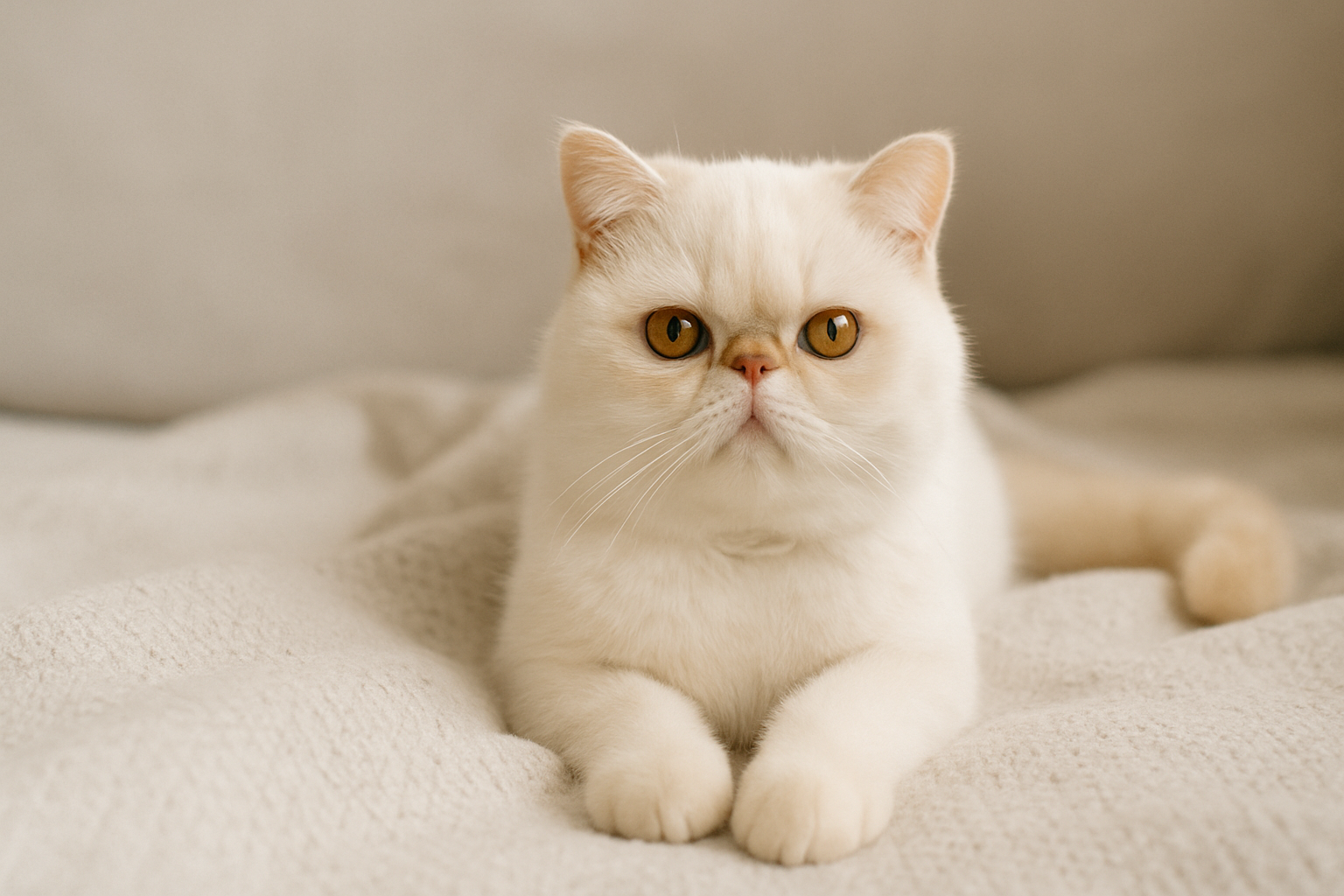
Exotic Shorthair cats have all the round-faced charm of a Persian, just without the grooming marathon. They share the same flat face, big round eyes, and sweet, settled personality, but the coat is short and plush instead of long and flowing. It’s the look without the daily commitment.
They’re also one of the most relaxed breeds you can bring home. They’re affectionate without being demanding, playful in short bursts, and perfectly content to just be in the same room as you. The flat face does come with some real health considerations though, and while the coat is lower maintenance than a Persian’s, it still needs regular brushing and upkeep.
Quick Breed Facts
- Origin: United States
- Breed registries: CFA, TICA, FIFe, GCCF
- Weight range: 8–15 lbs
- Lifespan: 12–15 years
- Coat: Short, dense, plush
- Colors and patterns: Solid, tabby, bicolor, calico, colorpoint, and more
- Eye color: Copper, gold, green, blue, or odd-eyed depending on coat
- Grooming: Low to moderate
- Activity level: Low to moderate
- Affection level: High
- Vocality: Quiet
- Good with children: Yes
- Good with other pets: Yes
History & Origin of the Exotic Shorthair Cat
The Exotic Shorthair was developed in the United States during the 1950s, when American breeders started crossing Persians with American Shorthairs. The original intent was to bring the Persian’s silver coat color into the American Shorthair line, but the resulting kittens had something unexpected, the Persian’s round face and sweet temperament paired with a short, plush coat. Breeders realized they had stumbled onto something worth pursuing in its own right.
Over the next decade, Burmese and Russian Blue cats were also briefly added to the breeding program to help refine the short coat before the breed was stabilized by crossing back exclusively to Persians. The Cat Fanciers’ Association officially recognized the Exotic Shorthair in 1967, and the breed has remained one of the most popular shorthaired pedigreed cats in the world ever since. By breed standard, the Exotic is essentially a Persian in every way except coat length.
Exotic Shorthair Personality & Temperament
Exotic Shorthairs are calm, sweet-natured, and quietly affectionate. They tend to follow their people around the house in a low-key way, settling nearby rather than climbing into your lap and demanding attention. They want to be part of what you’re doing, but they’re not going to make a fuss about it. It’s one of the most laid-back temperaments you’ll find in a pedigreed cat.
They’re also quiet. Exotic Shorthairs rarely meow, and when they do it’s usually soft and brief. They’re playful in short bursts rather than hours of nonstop energy, which suits people who like a cat with personality but not a cat that turns the house upside down. Their gentle, tolerant nature makes them a strong choice for families, first-time owners, and anyone who wants a companion that fits easily into a quieter household.
Exotic Shorthair Appearance & Physical Traits
The Exotic Shorthair has the same cobby, heavy-boned body as the Persian, with short legs, a broad chest, and a thick neck. The face is the most distinctive feature, flat with a short, snub nose, full cheeks, and large round eyes set wide apart. The overall impression is round. The head, eyes, and body all have a soft, circular shape that gives them their signature teddy-bear look.
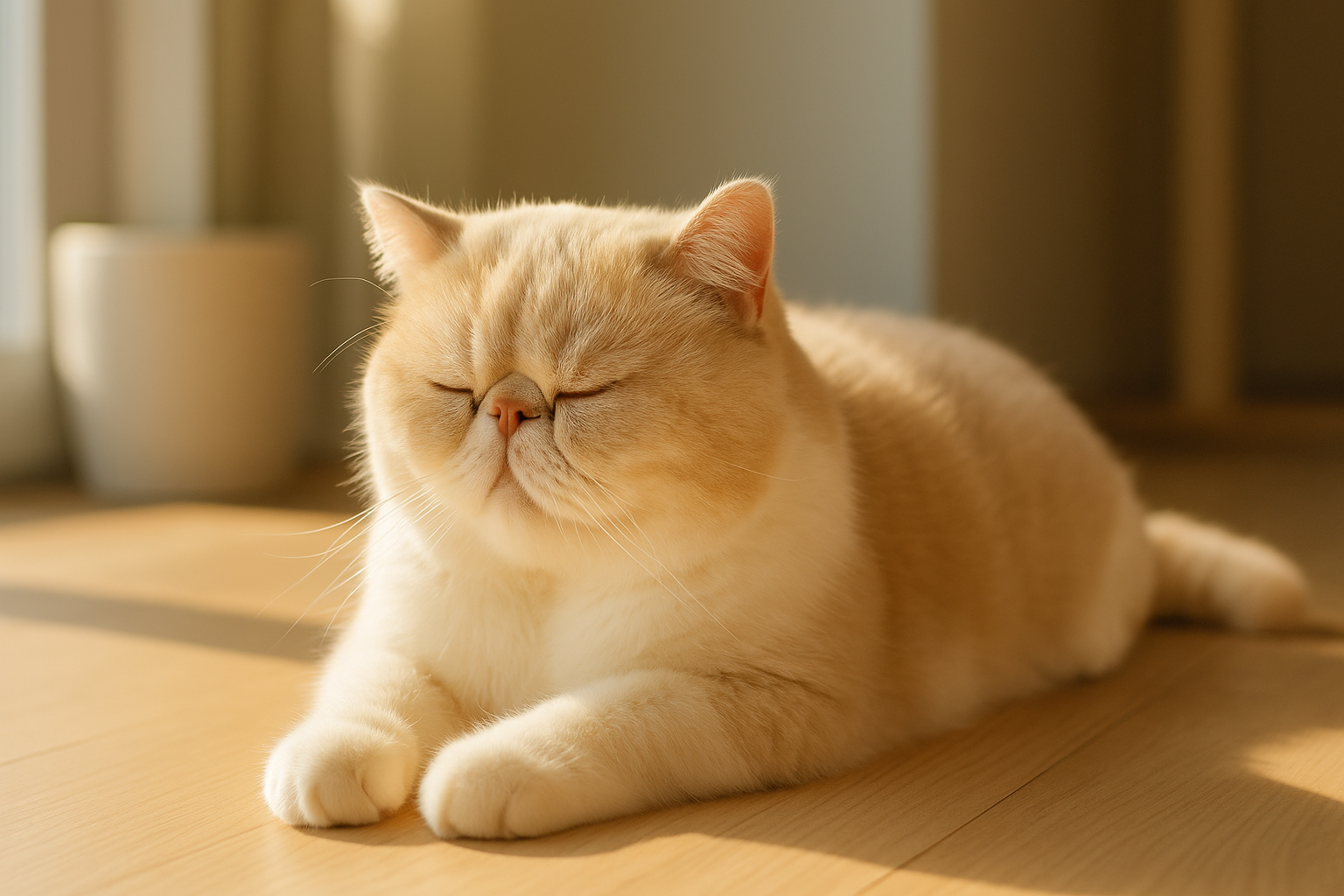
The coat is short but noticeably thicker and softer than most shorthaired breeds, standing slightly away from the body to give that plush, padded look. Exotic Shorthairs come in an enormous range of colors and patterns, from solid black, white, and blue to tabby, calico, bicolor, and colorpoint. Eye color varies with coat, with copper being the most common, though colorpointed cats have blue eyes and silver or golden cats often have green.
Exotic Shorthair Grooming & Shedding
Grooming an Exotic Shorthair is far easier than grooming a Persian, which is part of the appeal, but it’s not entirely hands-off. The dense double coat sheds year-round and benefits from a thorough brushing once or twice a week to remove loose hair and prevent the occasional tangle. Shedding picks up noticeably in spring and fall, so more frequent brushing during those periods helps keep things under control.
The flat face needs its own routine. Tear staining is common in this breed because the shortened tear ducts don’t drain properly, leaving wet streaks under the eyes that can turn reddish-brown over time. Wiping the area daily with a soft damp cloth keeps staining minimal and prevents skin irritation. Nail trims every couple of weeks and regular dental care round out the basics.
Activity & Play
Exotic Shorthairs are on the low end of the activity scale. They enjoy short, gentle play sessions with feather wands, crinkle balls, or soft plush toys, but they’re not going to spend hours racing around the house. Most are happy with ten or fifteen minutes of interactive play a couple of times a day, followed by a long nap on whatever soft surface is closest.
They do appreciate a low to mid-height cat tree or window perch, mostly for watching the world rather than climbing. Their cobby build and short legs make them less athletic than leaner breeds, so leaping and high jumping aren’t really in their toolkit. Keeping play sessions consistent helps prevent the weight gain this breed is prone to, since they’d otherwise happily skip exercise entirely.
Exotic Shorthair Health & Lifespan
Exotic Shorthairs typically live 12 to 15 years, with some reaching beyond that with good care. Because the breed was stabilized by crossing back to Persians, Exotics inherited the same flat-faced anatomy and the health profile that comes with it. Brachycephalic airway syndrome is the main concern, and it can show up as snoring, snorting, or noisy breathing at rest. Severely flat-faced cats may also struggle in hot weather or after even mild exertion. Dental crowding is another regular issue, since the compressed jaw doesn’t leave much room for a full set of teeth to sit properly.
Polycystic kidney disease (PKD) is the most significant hereditary risk, carried directly over from Persian lines. The PKD1 gene test identifies carriers with near-total accuracy, so any breeder you’re considering should be able to show you negative test results for both parents. Ask for documentation, not just a verbal assurance. Hypertrophic cardiomyopathy also appears occasionally and is worth screening for, particularly as the cat ages.
Weight is the other thing to watch closely. Exotics combine a low activity level with a hearty appetite, which makes them prone to packing on extra pounds if they’re free-fed. Extra weight also makes the breathing issues worse, so measured portions on a regular schedule work better than leaving food out. A high-protein, meat-based diet supports lean muscle and helps keep them comfortable as they age.
Family Compatibility
Exotic Shorthairs handle family life with the same patience as a Persian but with a touch more flexibility, partly because they’re not tied to a daily grooming routine that can make a Persian feel like a delicate project. They’re calm around children, tolerant of other cats and respectful dogs, and unbothered by most everyday household noise. They tend to spread their affection across the whole family rather than picking one person, which works well in busier homes.
That said, they’re not a high-energy breed and don’t enjoy rough handling. Households with very young children or boisterous dogs that won’t leave a cat alone aren’t a great match. Exotic Shorthairs also suit seniors and solo owners particularly well, since they’re content with a quieter routine and don’t need constant interaction to stay happy. They handle moderate alone time without much fuss, but they do appreciate company in the evenings.
Recommended Supplies for an Exotic Shorthair
The right setup for an Exotic Shorthair focuses on comfort, easy access, and gentle stimulation.
- Wide, shallow food and water bowls to accommodate their flat faces
- Low-dust, unscented litter for sensitive airways
- Roomy litter box with low entry for their short legs
- Soft, plush bed or covered cat cave for napping
- Low to mid-height cat tree with stable perches
- Soft damp cloths or pet wipes for daily face cleaning
- Sturdy scratching post or horizontal scratcher

Product Tip: Exotic Shorthairs can be sensitive to dust and odors thanks to their flat faces. A low-dust, unscented litter like Dr. Elsey’s Ultra helps keep their environment cleaner and more comfortable.
Exotic Shorthair Price and Cost
Pet-quality Exotic Shorthair kittens from a reputable breeder typically run between $1,200 and $2,500, with show-quality kittens from champion lines often pushing past $3,000. Because the breed shares Persian health risks, including PKD and brachycephalic concerns, paying for a breeder who tests their cats is one of the more important decisions you’ll make. Exotic Shorthairs are uncommon in general shelters, but Persian and flat-faced breed rescues occasionally take them in, and adopting an adult through one of those is often the most affordable way to bring this breed home.
Exotic Shorthair FAQs
Are Exotic Shorthair cats hypoallergenic?
No. Exotic Shorthairs are not hypoallergenic. They shed year-round and produce the same Fel d 1 protein as other cats, so they’re not a good fit for anyone with significant cat allergies.
How long do Exotic Shorthair cats live?
Most Exotic Shorthairs live 12 to 15 years with proper care. Keeping them lean, managing the flat-face health issues, and screening for hereditary conditions like PKD all support a longer, healthier life.
Do Exotic Shorthair cats shed a lot?
They shed moderately year-round, with heavier shedding in spring and fall. Their dense double coat needs brushing once or twice a week to manage loose hair and prevent occasional tangles.
Are Exotic Shorthair cats good with kids or other pets?
Yes. They’re calm, patient, and tolerant, which makes them one of the better breeds for families with children and other animals. They tend to get along with cat-friendly dogs when introduced gradually.
What’s the difference between an Exotic Shorthair and a Persian?
Coat length is the main difference. Exotic Shorthairs share the same body type, facial structure, temperament, and hereditary health profile as Persians, but their short, plush coat needs a quick weekly brush instead of daily detangling. For most owners, that one change is what makes the breed feasible day to day.
Do Exotic Shorthair cats have health problems?
They can. The flat face brings breathing, dental, and tear duct issues, and the breed carries a risk of polycystic kidney disease inherited from Persian lines. Choosing a breeder who screens for PKD and avoids extremely flat facial structures helps reduce these risks.
Is the Exotic Shorthair Right for You?
If you want a calm, affectionate, low-key cat with the round-faced Persian charm but without the daily grooming marathon, the Exotic Shorthair is probably the breed for you. They suit families, seniors, first-time owners, and anyone who prefers a quiet companion that’s content to share the couch rather than rule the house.
The trade-off is the flat face. Exotic Shorthairs come with real health considerations around breathing, tear staining, and hereditary kidney disease, and those aren’t things to take lightly. If you go in with a clear-eyed view of what the breed needs, including a vetted breeder and a willingness to keep up with face cleaning and weight management, you’ll have one of the sweetest cats around.
Debbie Reid is the founder and chief editor of CatPedia.net, with over 25 years of hands-on experience in feline care, rescue, and behavior research. Inspired by her rescue cats Snickers and Bigboy, she collaborates with animal welfare resources and consults veterinary literature to turn complex feline health, nutrition, and behavior topics into clear, actionable guides.