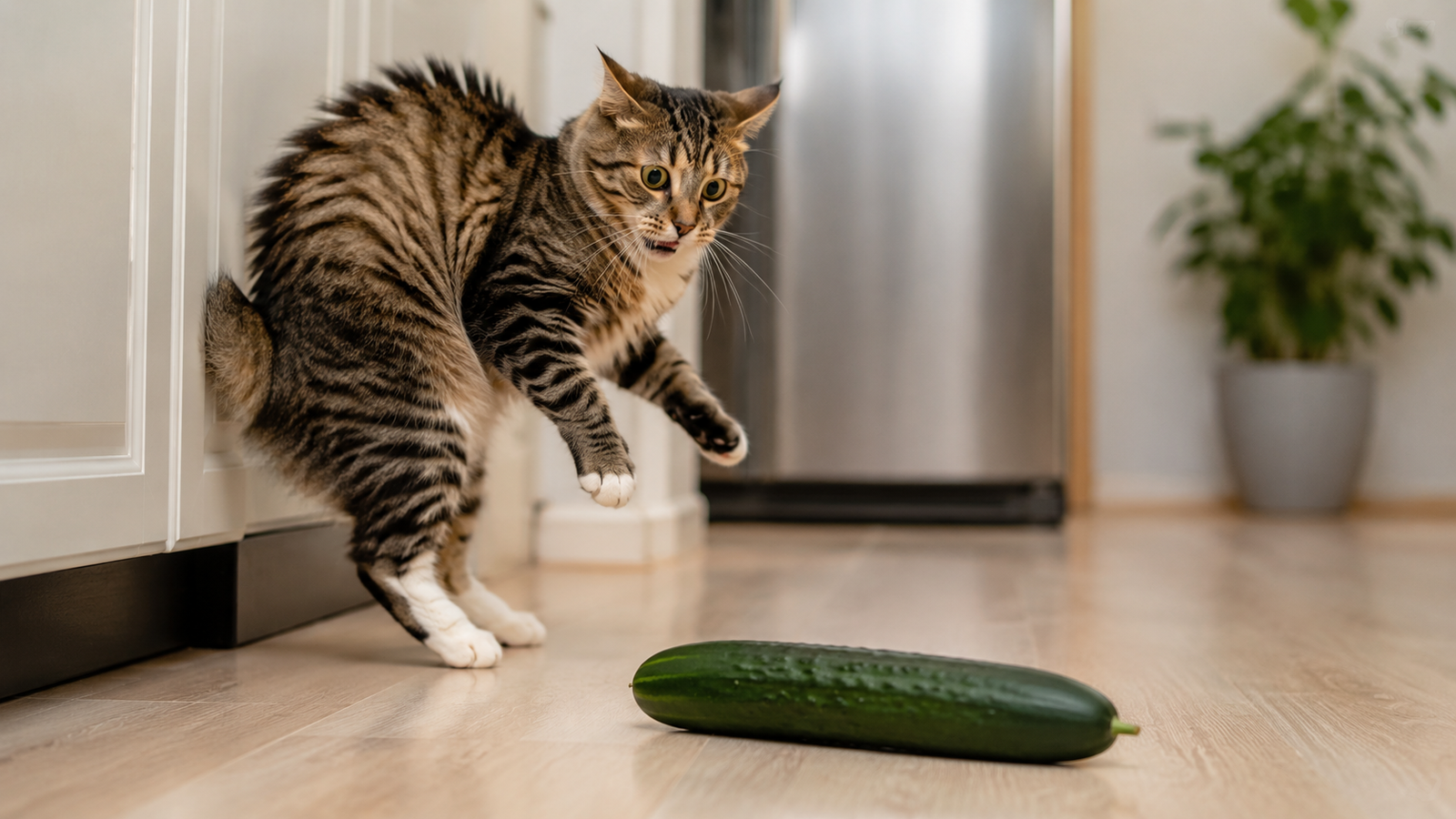
Videos of cats launching into the air after spotting a cucumber behind them have been circulating online for years. The reactions are dramatic enough that they usually trigger one of two responses: concern that something is wrong with the cat, or guilty laughter you feel slightly bad about afterward.
The good news is that these cats are perfectly fine. What you’re seeing is not a bizarre fear of cucumbers or proof that cats are secretly terrified of vegetables. It’s just pure instinct.
It’s Not Really About the Cucumber
Most cats are not afraid of cucumbers specifically. What triggers that dramatic leap is much more basic. It’s the surprise of finding something unexpected in a spot they thought was safe and familiar.
In nearly every one of those videos, the cat is eating or drinking, relaxed with their guard completely down, when a cucumber is quietly placed behind them. By the time they turn around, there’s a large unfamiliar object right where there was nothing a moment ago, and their instincts kick in before they’ve had time to process what they’re actually looking at.
That response is completely normal. Cats are wired to react fast to anything out of place in their environment. In the wild, hesitating when something unexpected appears could mean real danger. Your cat isn’t being dramatic. They’re doing exactly what their instincts are built to do.
Why the Feeding Area Makes It Worse
The location plays a big role in how dramatic the reaction is. Cats expect to feel safe and relaxed near their food bowls. It’s familiar territory, a place your cat associates with comfort and routine.
Discovering a strange object right behind them in that moment hits differently than spotting the same object across the room. It feels like an intrusion into a space where your cat expected everything to be exactly as they left it.
Do Cats Think Cucumbers Are Snakes?
It’s a popular theory, and honestly, it’s a reasonable one. The long, curved green shape of a cucumber does have a passing resemblance to a snake, and cats have an instinctive wariness around anything that might look like one.
That said, most behavior experts believe the surprise is the bigger factor. Cats tend to react similarly to other unexpected objects placed silently behind them. It doesn’t have to look like a predator to trigger the response. It just has to appear somewhere it wasn’t before.
Is It Harmful to Scare Your Cat This Way?
It can be, and this is worth taking seriously.
A panicked cat moves fast and doesn’t always land well. Some cats slam into furniture, skid across hard floors, or jump at awkward angles while scrambling to escape. For older cats or cats with joint issues, that sudden burst of movement can lead to real injuries.
There’s also the emotional side. Cats thrive on routine and predictability, and turning mealtime into something stressful can leave a lasting impression. A cat who has been startled repeatedly near their food bowl may start to feel anxious in that space, eating less, avoiding the area, or becoming generally more skittish around the house.
Some cats shake it off quickly. Others stay stressed much longer than you’d expect. If your cat already tends to be anxious or nervous, intentionally startling them probably isn’t a good idea.
Why Some Cats Don’t React at All
Not every cat takes the bait, and that’s completely normal too.
Confident, laid-back cats often spot the cucumber before turning around suddenly, giving them enough time to process it calmly. Others just have a naturally lower startle response and are more likely to sniff the thing than flee from it.
Personality matters a lot here. Just like people, some cats are naturally more cautious and reactive, while others take unexpected things in stride. Neither reaction means anything is wrong with your cat.
Better Ways to Keep Your Cat Curious and Engaged
Cats genuinely love mental stimulation and play. They just don’t need fear to get there. Wand toys, puzzle feeders, treat games, and climbing spaces all tap into the same hunting instincts without the stress.
Interactive play also does something that pranks never will: it builds trust. A few short play sessions each day can do more for your cat’s happiness and confidence than any prank ever will.

Nothing to Worry About
What looks like cucumber-specific terror is really just your cat’s instincts reacting to something unexpected appearing nearby. The dramatic jumps may look funny in videos, but they’re rooted in the same fast reflexes cats rely on to stay alert.
Debbie Reid is the founder and chief editor of CatPedia.net, with over 25 years of hands-on experience in feline care, rescue, and behavior research. Inspired by her rescue cats Snickers and Bigboy, she collaborates with animal welfare resources and consults veterinary literature to turn complex feline health, nutrition, and behavior topics into clear, actionable guides.