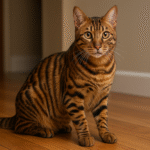
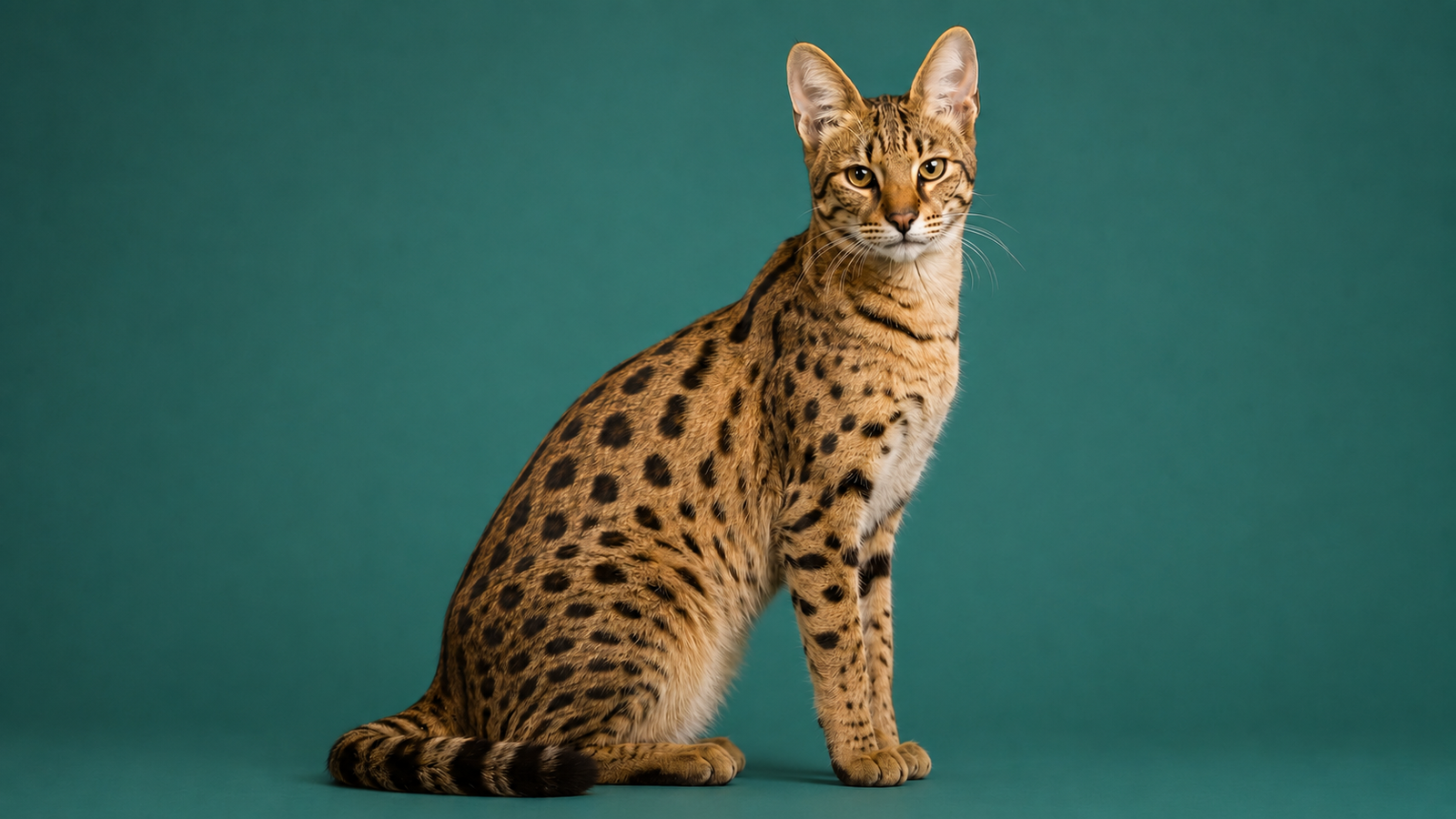
The Savannah cat is a hybrid breed created by crossing a domestic cat with an African Serval, a medium-sized wild cat native to sub-Saharan Africa. The result is a cat with the spotted coat and long-legged build of its wild parent, but the personality of a dog. That wild ancestry also makes them one of the most heavily regulated cat breeds in the United States.
Savannahs are categorized by generation, from F1 (50% Serval) through F5 and beyond, with state laws varying by how far removed the cat is from its wild parent. Hawaii, Georgia, and Rhode Island ban them outright, while New York only allows F5s and later generations.
Quick Breed Facts
- Origin: United States
- Breed registries: TICA (Championship 2012)
- Weight range: 10–25+ lbs depending on generation
- Height: 14–18 inches at the shoulder (F1s are the tallest domestic cats)
- Lifespan: 12–20 years
- Coat: Short, dense, slightly coarse guard hairs
- Colors and patterns: Brown spotted tabby, silver spotted tabby, black, black smoke
- Eye color: Gold, green, hazel
- Grooming: Low
- Activity level: Very high
- Affection level: High
- Vocality: Moderate to high
- Good with children: Yes with older children (later generations only)
- Good with other pets: Sometimes, depending on generation and socialization
- Legality: Restricted or banned in multiple US states
History & Origin of the Savannah Cat
The Savannah traces back to a single kitten born on April 7, 1986, when a Bengal breeder named Judee Frank paired a male African Serval with a Siamese cat. The kitten was named Savannah, and she became both the namesake and the foundation of the breed. In 1989, Savannah was bred with a Turkish Angora and produced the first viable F2 kittens. From there, the Savannah began to take shape as a deliberate breed.
Patrick Kelley and Joyce Sroufe drove the breed’s development through the 1990s. Kelley obtained kittens from Savannah’s later litters and worked with Sroufe, an exotic cat breeder, to write and present the Savannah breed standard to TICA in 1996. TICA accepted the Savannah for registration soon after and granted the breed full Championship status in 2012. It remains a TICA-only breed. CFA does not recognize the Savannah, and neither do most European registries.
Savannah Cat Generations Explained: F1 Through F5 and SBT
The letter F stands for filial, meaning generation, and the number indicates how many generations the cat is removed from its Serval ancestor. Generation drives size, appearance, temperament, price, legal status, and even fertility, so it’s the first question any prospective owner should ask about the cat they’re considering.
Here’s how the generations break down in practical terms:
| Generation | % Serval | Typical Weight | Price Range | What to Know |
|---|---|---|---|---|
| F1 | ~50% | 17–25+ lbs | $12,000–$25,000+ | Largest and wildest temperament; experienced exotic owners only |
| F2 | ~25–37.5% | 16–25 lbs | $4,000–$11,000 | Still large and wary of strangers; suited to experienced cat owners |
| F3 | ~12.5–25% | 10–17 lbs | $2,500–$6,000 | Tolerates noise and unpredictability better than F1/F2; suited to active households with older children |
| F4 | ~15% | 10–15 lbs | $1,500–$4,000 | First SBT-eligible generation; fits most family homes |
| F5+/SBT | 3–12% | 10–15 lbs | $1,000–$3,000 | Most predictable temperament; widest legal acceptance |
SBT stands for Stud Book Traditional, a TICA designation given to Savannahs that are at least four generations removed from the Serval and produced by breeding Savannah to Savannah, with no domestic outcrosses in the three previous generations. SBT cats are considered “pure” Savannahs and are the only ones eligible to compete in TICA Championship shows.
Savannah genetics have one wrinkle that matters before you buy: males are typically sterile until F5 or later, while females are fertile from F1 onward. This is why breeding programs almost always retain early-generation females and pair them with fertile later-generation males or domestic outcrosses.
In practical terms, if you want an F1, F2, or F3 kitten, you’ll almost certainly be offered a male, since the females are kept for breeding. In F4 and later generations, the situation flips, and females are more commonly available as pets. Litters are also small, typically four to six kittens, so waiting lists at reputable breeders are common.
Savannah Cat Personality & Temperament
Savannahs are often described as more dog than cat, and it’s a fair description. Most of it comes down to intelligence. They solve problems quickly, remember routines, and figure out how to open cabinets, doors, and drawers within days of moving in. That’s also what makes them trainable. Many will play fetch without any coaching, learn to walk on a leash, and pick up new tricks faster than most domestic breeds.
They bond hard with their people, follow them from room to room, and take an active interest in whatever is happening in the house. They’re loyal and highly interactive, but not lap cats. A Savannah wants to be near you and involved in what you’re doing, not held or cuddled.
Personality varies significantly by generation. F1 and F2 cats tend to bond intensely with one or two people, are often wary of strangers, and can act unpredictably around unfamiliar people or environments. F3 cats are noticeably calmer and more social than F1 or F2, while still carrying a visibly wild look. F4, F5, and SBT cats continue that trend, reading closer to a confident, predictable domestic cat.
Regardless of generation, Savannahs are vocal. Expect chirps, trills, meows, and the occasional yowl.
Savannah Cat Appearance and Physical Traits
The Savannah’s build is closer to its Serval ancestor than to any other domestic cat. Long legs, a long neck, a small triangular head, and large ears set high on the skull all trace back to that wild ancestry. The back legs sit slightly higher than the front, producing the almost giraffe-like stance of the Serval. The breed standard also prizes ocelli markings on the backs of the ears, pale spots surrounded by darker coloring.
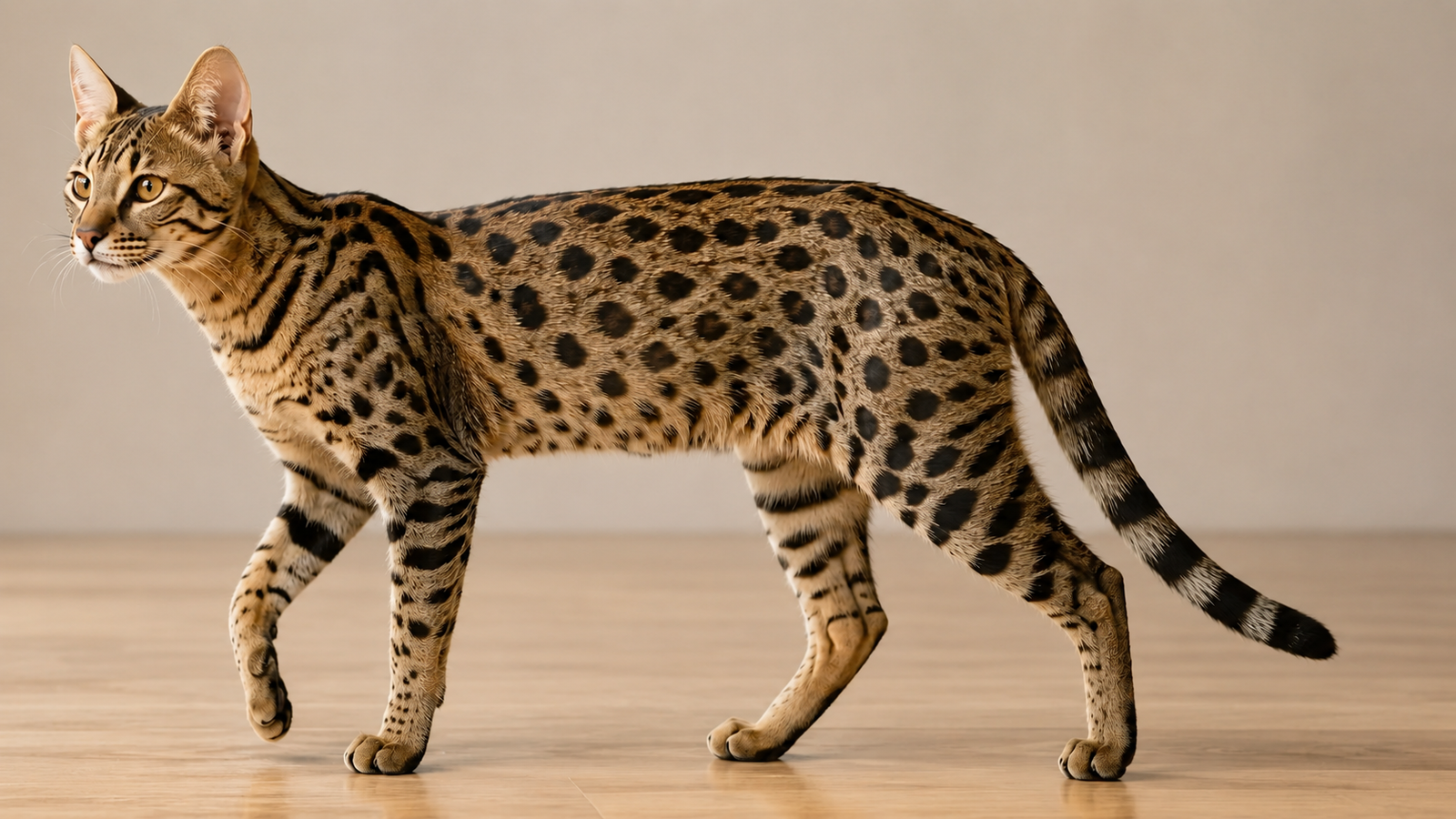
The coat is short to medium, with slightly coarse guard hairs over a softer undercoat and dark spots that contrast clearly with the base color. TICA recognizes four color combinations: brown spotted tabby, silver spotted tabby, black, and black smoke. Other colors sometimes marketed as rare, including blue, cinnamon, and white, fall outside the breed standard.
Average Savannahs stand 14 to 17 inches at the shoulder, and the breed holds the Guinness World Record for tallest domestic cat. Fenrir, an F2 Savannah, was measured at 18.83 inches in 2021 and officially recognized in 2022.
Legality: Where Savannah Cats Are Banned or Restricted
Where you can legally own a Savannah cat varies more than almost any other pet. Regulations are set at the state, county, and sometimes municipal level, and enforcement can include confiscation of the cat. Laws change, so always verify current regulations with your state wildlife or agriculture department before committing to a purchase.
As a general guide based on current state law:
- Banned outright (all generations): Hawaii, Georgia, Rhode Island, Nebraska
- F4 or later only: Alaska, Colorado, Iowa, Massachusetts, New Hampshire, Vermont
- F5 or later only: New York state
- Weight restriction: Maryland (must be under 30 pounds)
- City-level bans: New York City (all generations), Denver, Seattle
- Permit or local rules may apply: Indiana, New Mexico, Oregon
California is a particularly complicated case. The California Department of Fish and Wildlife enforces restrictions on wild-domestic hybrids under state Fish & Game Code, and earlier-generation Savannahs are generally prohibited. Interpretation of the law at F5 and later varies by county, so anyone in California should confirm with local animal control before buying.
State and local laws use the F-generation to decide whether a cat is treated as a domestic pet or a regulated wildlife hybrid. F1 through F3 cats retain enough Serval ancestry that they’re classified as hybrids in most jurisdictions. F4 clears that threshold in most states, making it the most widely legal generation for pet ownership, though a few states like New York require F5 or later.
Homeowners’ associations and rental properties may also have their own rules against exotic pets. Check your lease and HOA agreement before you buy.
Savannah Cat Grooming and Shedding
Grooming a Savannah is one of the easiest parts of owning one. The short, dense coat sheds moderately, doesn’t mat, and needs only a weekly brush to keep loose hair under control. A grooming glove or rubber curry brush works well and doubles as bonding time, which most Savannahs tolerate better than being held still with a stiff brush.
Beyond coat care, the usual routine applies. Nails need trimming every couple of weeks, and ears should be checked regularly for wax or debris. Dental care matters more than in many breeds, since Savannahs live long enough for periodontal disease to become a real issue over time. Starting nail trims and tooth brushing while they’re kittens makes the adult routine much easier.
Activity & Play
Savannahs are one of the most active breeds in existence, and their exercise needs are closer to a working dog than a housecat. They run, climb, leap, and investigate constantly. Standing jumps of six feet or more are common, and vertical space isn’t a nice-to-have with this breed. It’s structural.
A tall, heavy cat tree is a starting point, but many Savannah owners add wall-mounted shelves, catwalks, or a fully enclosed catio to give the cat somewhere legitimate to channel all that energy.

Water is another quirk to plan for. Many Savannahs will play in sinks, swat at running faucets, wade in shallow tubs, and supervise showers uninvited. Lightweight water dishes are easy for them to tip, so a heavy ceramic bowl or a cat water fountain works better.
Daily interactive play, leash training, and puzzle feeders help keep a Savannah physically and mentally engaged. Without enough stimulation, they can become destructive.
Savannah Cat Health and Lifespan
Savannahs typically live 12 to 15 years, with some reaching into their 20s. The breed is generally healthy, but responsible breeders screen for a handful of inherited and breed-associated conditions.
Hypertrophic cardiomyopathy, or HCM, is the most common heart disease in cats, and it has been reported in Savannahs. HCM can develop silently and, in advanced cases, lead to heart failure or sudden death. There’s no Savannah-specific genetic test for HCM, so ask a breeder when the parents were last screened with an echocardiogram.
Pyruvate kinase deficiency is an inherited condition that can cause intermittent anemia. Progressive retinal atrophy is a separate inherited condition that gradually damages the retina and can lead to blindness. Both have DNA tests available, and reputable breeders test their cats for both before breeding.
Savannahs don’t need a raw or specialty diet. A complete and balanced commercial food appropriate for the cat’s life stage already supplies the protein, taurine, and nutrients they need. Because size and activity level vary so much by generation, portions should be adjusted to keep the cat lean rather than following a fixed amount.
Family Compatibility
Savannahs can work well in family homes, but the fit depends heavily on both generation and household. The Savannah Cat Association recommends F3 or later for homes with infants or young children, since these generations are calmer and more predictable than F1 or F2. F4, F5, and SBT cats continue that trend and tend to be the easiest fit for busy households.
Savannahs are large, fast, and often rough during play, and young children don’t always recognize when a cat has had enough. Early-generation cats (F1, F2) are better suited to experienced adult owners without small children.
Dogs generally do fine with Savannahs, particularly cat-friendly breeds introduced gradually. Small pets like hamsters, birds, and fish require more caution. Savannahs have a strong prey drive, so cages, tanks, and other enclosures need to be fully secured and kept where the cat can’t reach them.
They can also live with other cats, although their size and energy may overwhelm quieter breeds. An active, confident cat like the Abyssinian is usually a better match than a laid-back one.
Recommended Supplies for a Savannah Cat
Savannahs need supplies built for a big, athletic cat that treats the house like an obstacle course. Most gear made for an average-sized cat won’t hold up to a cat this large, this strong, or this curious.
- Tall, heavy-duty cat tree with stable base and multiple perches
- Wall-mounted shelves or catwalks for vertical navigation
- Oversized litter box with high sides
- Heavy ceramic water bowl or cat water fountain
- Puzzle feeders and interactive toys for mental stimulation
- Harness and leash for supervised outdoor time
- Sturdy scratching posts at multiple heights
- Enclosed catio or secure outdoor space if possible

Savannah Cat Price
Savannah pricing is driven almost entirely by generation and sex. F1 kittens carry the highest prices, and those sold as pets are often male, since females are commonly kept for breeding.
F1 kittens run $12,000 to $25,000 or more. F2 cats typically cost between $4,000 and $11,000, F3 between $2,500 and $6,000, F4 between $1,500 and $4,000, and F5 or SBT kittens usually fall between $1,000 and $3,000.
Savannahs are frequently underestimated on energy and legal requirements, so they end up rehomed as adults more often than most breeds. Savannah Cat Rescue is a good option for anyone open to skipping the kitten stage for a lower price and a cat whose temperament is already established.
Savannah Cat FAQs
How much is a Savannah cat?
Prices depend almost entirely on generation. F1 kittens run $12,000 to $25,000 or more, F2s typically $4,000 to $11,000, F3s $2,500 to $6,000, F4s $1,500 to $4,000, and F5 or SBT kittens $1,000 to $3,000. Adoption through Savannah Cat Rescue is significantly cheaper and often involves adult cats with fully developed personalities.
What does F1, F2, F3, F4, and F5 mean in Savannah cats?
The F stands for filial, meaning generation. F1 is 50% Serval (one Serval parent), F2 is roughly 25% (Serval grandparent), F3 is around 12.5%, and F4 and F5 continue down from there. Lower F numbers mean larger cats, more wild traits, higher prices, and more legal restrictions.
Are Savannah cats legal to own?
It depends on where you live. Savannahs are banned outright in Hawaii, Georgia, Rhode Island, and Nebraska. Alaska, Colorado, Iowa, Massachusetts, New Hampshire, and Vermont allow only F4 or later. New York allows F5 or later, with a total ban in New York City. Denver, Seattle, and some other cities have their own bans. Always verify with state wildlife agencies before buying.
How big do Savannah cats get?
Size depends on generation. F1 males can reach 17 to 25+ pounds, while F2 cats are similar in size. F3 cats typically weigh 10 to 17 pounds. F4 and F5 cats usually settle between 10 and 15 pounds, comparable to a large domestic cat. The breed holds the Guinness World Record for tallest domestic cat, set by an F2 named Fenrir at 18.83 inches.
Are Savannah cats dangerous?
No, but early-generation cats need careful handling. F1 and F2 Savannahs are large, strong, and can be reactive around strangers or in chaotic environments, which is why breeders recommend them only for experienced owners. F3 and later generations are calmer and behave like any confident, athletic domestic cat. No generation is aggressive by default, but size and strength mean rough play or startled reactions carry more force than they would with a smaller breed.
Are Savannah cats hypoallergenic?
No. Some allergy sufferers report fewer symptoms around Savannahs due to their short coat and lower dander output, but they still produce the Fel d 1 protein that triggers most cat allergies. Spending time with a Savannah before committing is the only reliable way to know how your allergies will respond.
How long do Savannah cats live?
Most Savannahs live 12 to 15 years, with some reaching into their 20s. Regular vet care, a complete and balanced diet, and consistent exercise all support a longer lifespan.
Do Savannah cats like water?
Yes, and often to an unusual degree. Many will play in sinks, swat at faucets, wade in shallow tubs, and join their owners near the shower. It traces back to the Serval, which hunts near water in the wild.
Savannah cat vs Bengal: what’s the difference?
Savannahs are taller and leaner with the leggy build of the Serval, while Bengals are shorter, stockier, and more muscular. Bengals tend to be more consistently social with strangers, while Savannahs bond intensely with their family and can be reserved with visitors, especially in earlier generations. Bengals are legal in more places and typically cost less.
Is a Savannah cat bigger than a Maine Coon?
By height, yes. Savannahs are taller and leggier. By weight, it depends on generation. A large male Maine Coon at 20 to 25 pounds is typically heavier than most Savannahs outside the F1 and F2 generations. F1 Savannahs can match or exceed Maine Coons in weight, but F3 through F5 cats are generally lighter.
Is the Savannah Cat Right for You?
The Savannah is a good fit if you want a cat that acts more like a dog than a housecat and you can commit to the daily engagement, vertical space, and legal homework the breed requires.
If you can’t give them interactive play every day, don’t have room for a tall tree and wall shelves, or aren’t willing to verify state and local law before you buy, pick a different breed. Savannahs are regularly rehomed by owners who underestimated them for exactly those reasons.
If you can, match the generation to your experience level and choose a breeder who screens for HCM and socializes kittens early. Get those pieces right and you’ll have a cat that greets you at the door, follows you room to room, and never lets you forget they’re part of the household.
Debbie Reid is the founder and chief editor of CatPedia.net, with over 25 years of hands-on experience in feline care, rescue, and behavior research. Inspired by her rescue cats Snickers and Bigboy, she collaborates with animal welfare resources and consults veterinary literature to turn complex feline health, nutrition, and behavior topics into clear, actionable guides.