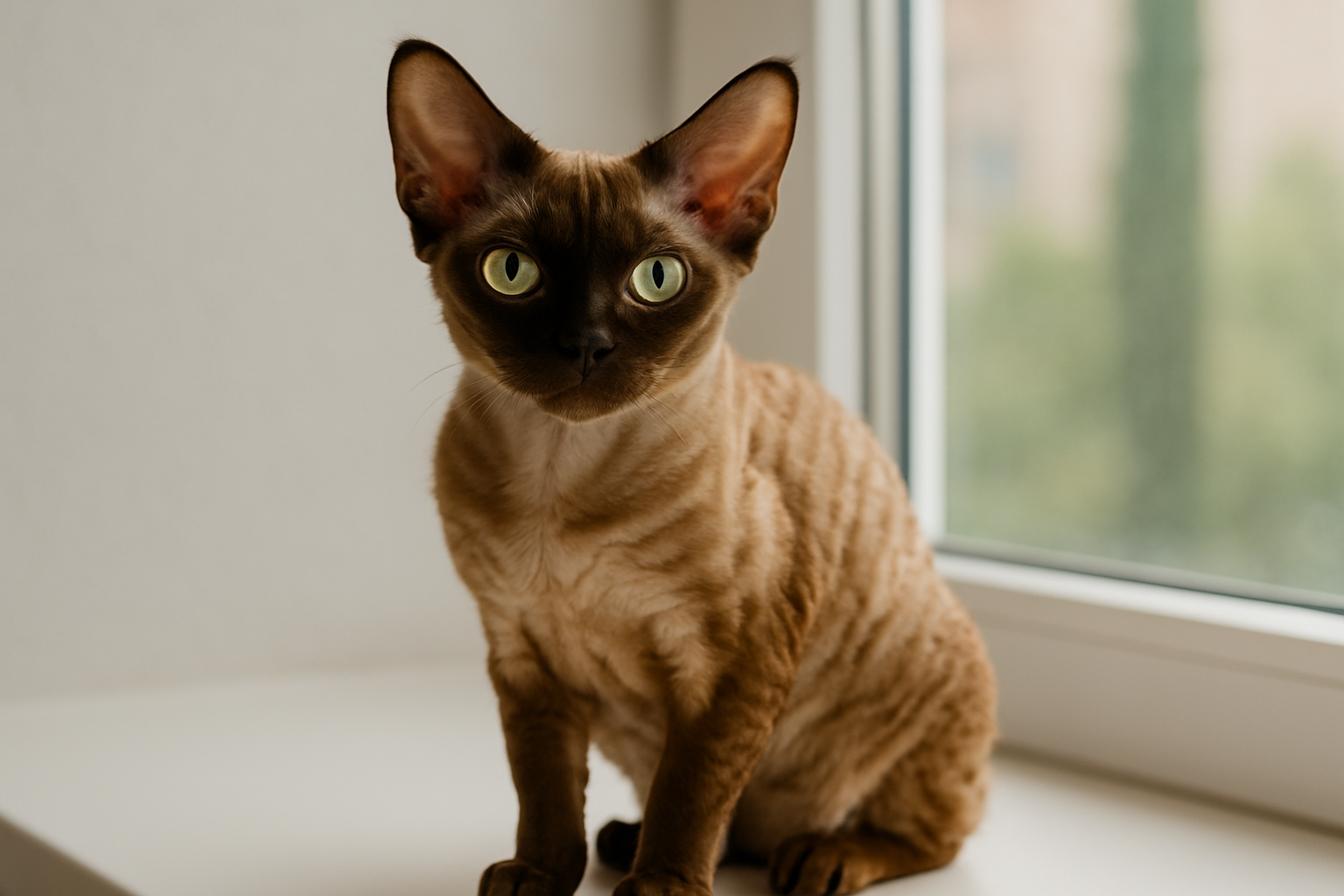
Devon Rex cats have a way of making an impression the moment you see one. The huge ears, the wide cheekbones, the soft wavy coat that looks like it belongs on a different planet entirely. They’re striking in a way that’s hard to pin down, with wide eyes and an almost pixie-like appearance.
They’re also more cat than most people expect. Devons are intensely social, physically active, and genuinely attached to their people in a way that leaves very little room for personal space. That’s a selling point for the right owner and a reality check for anyone picturing a self-sufficient house cat who naps eighteen hours a day.
Here’s what it’s actually like to live with a Devon Rex cat, from personality and daily habits to grooming, health, and whether they’re the right fit for your home.
Quick Breed Facts
- Origin: England (Devonshire)
- Breed registries: CFA, TICA, FIFe
- Weight range: 5–10 lbs
- Lifespan: 12–16 years
- Coat: Short, soft, wavy with minimal undercoat
- Colors and patterns: Wide variety, including solid, tabby, tortie, colorpoint, and more
- Eye color: Gold, green, blue, or odd-eyed
- Grooming: Low maintenance
- Activity level: High
- Affection level: Very high
- Vocality: Moderate
- Good with children: Yes
- Good with other pets: Yes
History & Origin of the Devon Rex Cat
The Devon Rex has a very specific origin story. In 1959, a curly-coated feral kitten named Kirlee was discovered near a tin mine in Devonshire, England. His unusual wavy coat caught the attention of a local cat enthusiast, and when breeders investigated further, they found the gene responsible for those curls was distinct from the mutation behind the Cornish Rex, a curly-coated breed that had appeared in England just a decade earlier. Kirlee became the foundation of an entirely new breed.
From that single kitten, selective breeding produced the Devon Rex as it exists today, compact, large-eared, and intensely social. CFA and TICA both recognize the breed, and its popularity has grown steadily since. The Devon Rex is sometimes confused with the Sphynx, particularly by people unfamiliar with both breeds, but the two are distinct: the Devon has a short, wavy coat and a different body structure, and the personality, while both breeds lean affectionate, has its own character.
Devon Rex Cat Personality & Temperament
Devon Rex cats are often described as dog-like, and it’s one of those comparisons that actually holds up. They follow their people from room to room, involve themselves in whatever is happening, and tend to treat laps, shoulders, and the space directly next to your face as their personal real estate. They’re not interested in watching from across the room. They want in on it.
They’re also genuinely playful well into adulthood. Devons stay kitten-curious for most of their lives, and many will learn tricks, engage with puzzle feeders, and return toys for another round of fetch without being trained to do so. Their intelligence means they pick things up quickly and get bored just as fast when there’s nothing to engage with. For the right owner, this is exactly what makes them so entertaining. For someone who travels frequently or prefers a more hands-off cat, it can be a lot to manage.
Devon Rex Cat Appearance & Physical Traits
The Devon Rex has a look that’s easy to recognize and harder to describe. The head is a modified wedge with a short muzzle, prominent cheekbones, and ears that are disproportionately large and set low on the sides of the head, giving the whole face an alert, slightly otherworldly expression. The eyes are wide-set and large, and the body underneath all of that is lean and athletic, more muscular than it first appears.
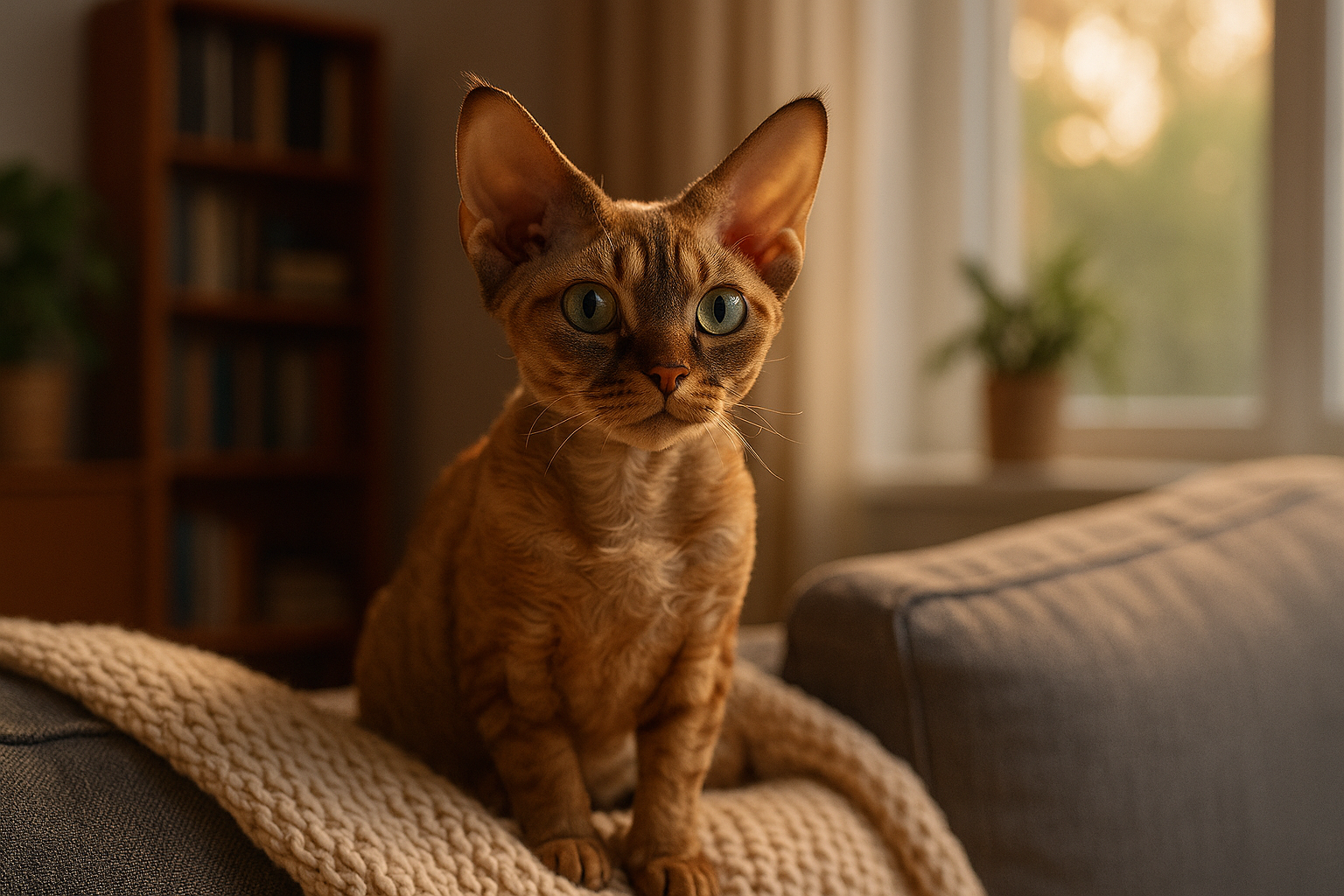
The coat is the other thing that sets them apart. It’s short and soft with a wavy or rippled texture, and it lacks the dense undercoat most cats carry. That absence of undercoat is part of why Devons shed so little compared to other breeds. Their tails are long and slender, and the overall silhouette is angular and fine-boned compared to rounder, stockier breeds. Devon Rex cats come in a wide range of colors and patterns, so appearance varies quite a bit from cat to cat beyond the shared structural traits.
Devon Rex Cat Grooming & Shedding
The Devon Rex is one of the easier breeds to care for when it comes to grooming, which surprises people who assume the wavy coat would require constant upkeep. It doesn’t. Their coat is sparse enough that a gentle wipe with a damp cloth once a week is usually enough to remove loose hair and skin oils. Brushing too aggressively can actually damage the delicate waves, so minimal handling works best.
Shedding is minimal by cat standards. The lack of a thick undercoat means you won’t find fur coating your furniture the way you would with a Maine Coon or even a short-coated breed with a heavier coat. Many allergy sufferers report tolerating Devon Rex cats better than other breeds, likely due to lower airborne dander, though no cat is truly hypoallergenic. Those large ears collect wax more readily than most, so occasional cleaning helps prevent buildup.
Activity & Play
Devon Rex cats are quick, agile, and built to prove it. They climb well and enthusiastically, and vertical space isn’t optional with this breed. A tall, solid cat tree is a starting point, not the whole solution. Devons benefit from daily interactive play, puzzle feeders, and enough environmental variety to keep them from redirecting their energy toward things you’d rather they left alone.
Many Devon Rex cats will play fetch, learn to walk on a leash, and figure out how to open cabinet doors if they decide there’s a reason to. Their intelligence tends to show up most clearly when they’re under-stimulated. A bored Devon Rex will find something to do.

Devon Rex Cat Health & Lifespan
Devon Rex cats typically live 12 to 16 years with good care. They’re generally a healthy breed, but there are a few hereditary conditions worth knowing about before bringing one home. Hypertrophic cardiomyopathy (HCM) is the most significant, a form of heart disease that thickens the heart walls and can develop without obvious symptoms. Regular cardiac screening is a good idea, especially as cats age. Patellar luxation, where the kneecap slips out of position, does occur in the breed and can range from mild to requiring veterinary management. A rare hereditary muscle condition called Devon Rex myopathy affects muscle function in some lines and is something responsible breeders screen for.
Because of their lean builds and minimal coat, Devon Rex cats are also more sensitive to temperature than many breeds. They seek out warm spots reliably and can get cold more quickly than a cat with a denser coat. A quality high-protein diet, consistent vet care, and keeping them at a healthy weight all support a long life. With good care, Devon Rex cats generally age very well.
Family Compatibility
Devon Rex cats do well in a wide range of households, which comes down to their genuinely social nature. They bond with multiple people rather than attaching exclusively to one, handle the activity of a busy home reasonably well, and tend to warm up to strangers fairly quickly rather than disappearing when guests arrive. They’re patient with children who interact with them respectfully, though their lean frames mean rough handling is something to watch for with younger kids.
They also tend to do very well with other cats and cat-friendly dogs when introduced properly. In many homes, Devons actively enjoy having another animal around to play, sleep, and interact with throughout the day. Because they’re such social cats, households where someone is home regularly or where another pet provides companionship usually suit them best.
Recommended Supplies for a Devon Rex Cat
Devon Rex cats need an environment built for their energy and their sensitivity to cold.
- Tall, sturdy cat tree with multiple levels and stable base
- Interactive toys including wand toys and puzzle feeders
- Soft, warm cat bed or heated pad for cold weather
- Lightweight cat sweater or wrap for drafty rooms or cooler seasons
- Wide, shallow food and water bowls to avoid whisker fatigue
- Roomy, consistently clean litter box

Devon Rex Cat Price and Cost
Devon Rex kittens from reputable breeders typically cost between $1,000 and $2,500, with price varying based on coat quality, color, and breeder reputation. Rarer color variations and show-quality cats from champion lines can push beyond that range. Responsible breeders invest in health screening for HCM and Devon Rex myopathy, which is reflected in the price. Adoption is also worth considering. Devon Rex cats do turn up in breed-specific rescues, often as adult cats from owners who underestimated how social and demanding this breed can be.
Devon Rex Cat FAQs
Are Devon Rex cats hypoallergenic?
Devon Rex cats are not officially hypoallergenic, but many allergy sufferers find them easier to tolerate than other breeds. Their minimal shedding and sparse coat produce less airborne dander, though they still produce the Fel d 1 protein that triggers most cat allergies. Spending time with a Devon Rex before committing is always a good idea if allergies are a concern.
Do Devon Rex cats shed a lot?
Very little. Their short, wavy coat lacks the dense undercoat most cats carry, which means far less loose fur on furniture and clothing than you’d see with most breeds. Occasional shedding still happens, but it’s minimal by any standard.
Are Devon Rex cats good with kids and other pets?
Yes. They’re playful, social, and tend to bond with the whole household rather than one person. They do well with respectful children and get along with other cats and cat-friendly dogs when introduced gradually.
What is the personality of a Devon Rex like?
Energetic, curious, and intensely people-oriented. Devon Rex cats want to be near their people, involved in what’s happening, and mentally engaged throughout the day. They’re affectionate without being passive, and most stay playful well into adulthood.
How much does a Devon Rex cat cost?
From a reputable breeder, expect to pay between $1,000 and $2,500 depending on lineage, coat quality, and color. Adoption through a breed-specific rescue is a more affordable option and worth exploring if you’re open to an adult cat.
Is the Devon Rex Cat Right for You?
If you want a cat with genuine personality, one that greets you at the door, follows you through your day, and makes it obvious it’s glad you’re there, the Devon Rex is difficult to beat. They suit active households, people who are home regularly, and anyone who genuinely enjoys interacting with their cat rather than simply coexisting with one. Their adaptable nature also helps them settle into a wide range of households once they feel comfortable.
They do need more from their people than many breeds. A Devon Rex that doesn’t get enough interaction, stimulation, or companionship will let you know. If that sounds manageable, or better yet appealing, this is one of the more rewarding breeds you can choose to live with.
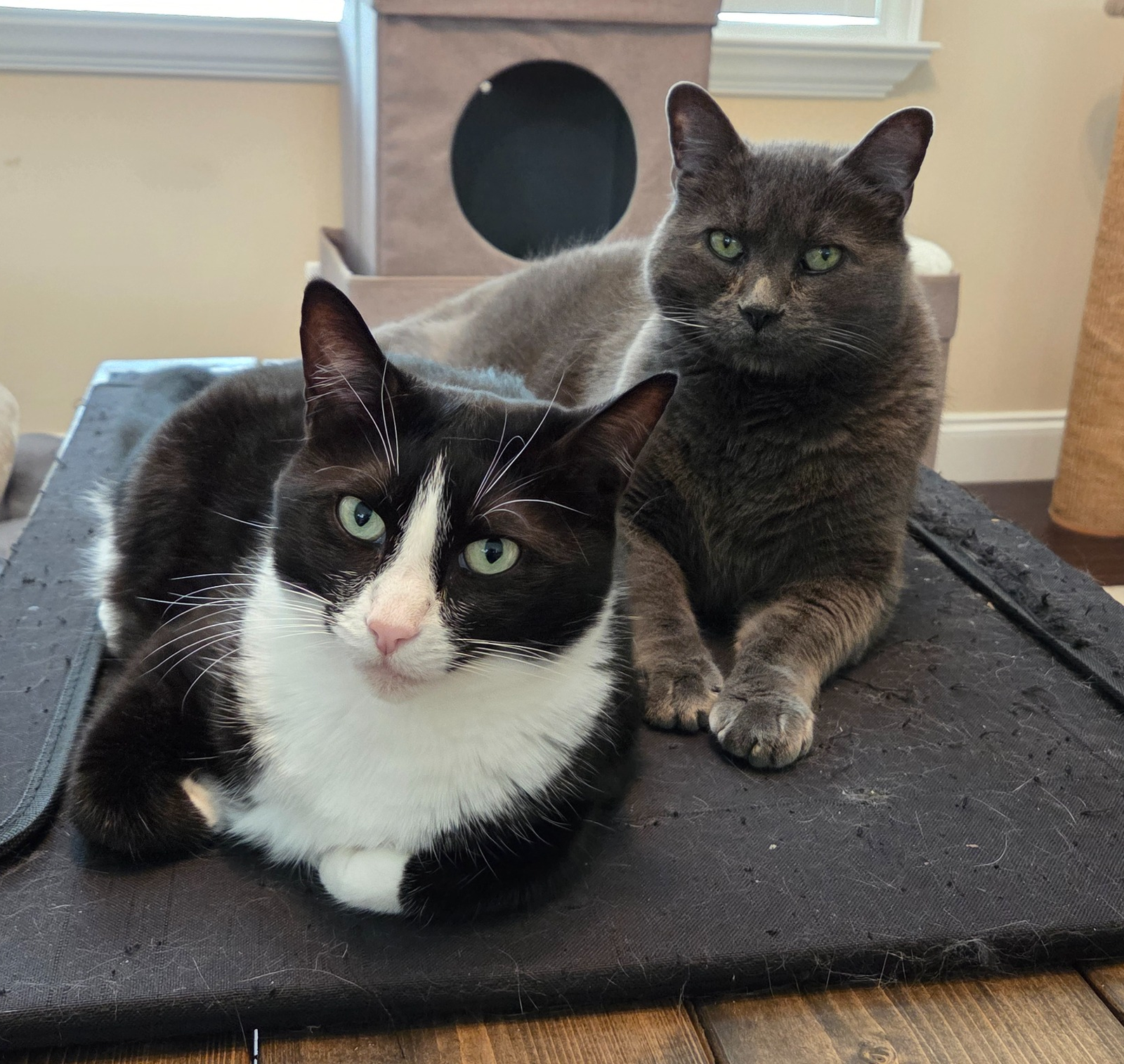
Debbie Reid is the founder and chief editor of CatPedia.net, with over 25 years of hands-on experience in feline care, rescue, and behavior research. Inspired by her rescue cats Snickers and Bigboy, she collaborates with animal welfare resources and consults veterinary literature to turn complex feline health, nutrition, and behavior topics into clear, actionable guides.