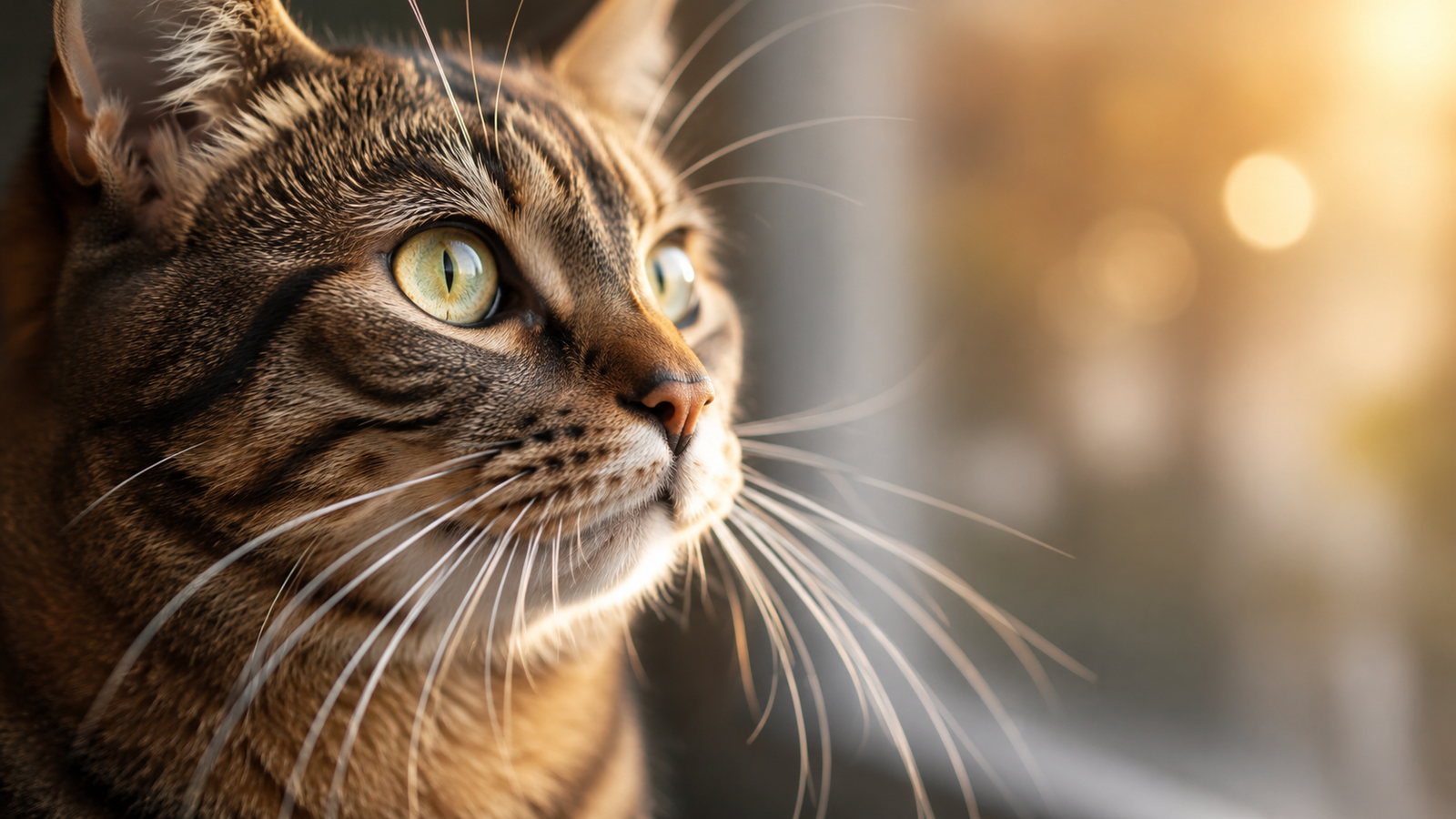
Those long hairs on your cat’s face are doing more work than you realize. They’re one of the most sophisticated sensing tools in the animal world, and your cat depends on them every time they move through a tight space, hunt a toy, or quietly judge whether the kitchen counter is worth the jump.
Why Do Cats Have Whiskers?
Cats have whiskers because their eyes alone aren’t enough to move through the world safely. Whiskers respond to contact, vibration, and tiny shifts in air movement, picking up information their vision can’t catch. That extra input helps cats move through dark spaces, judge narrow openings, track prey at close range, protect their eyes, keep their balance, and even communicate mood.
What Are Cat Whiskers, Exactly?
Cat whiskers are specialized sensory hairs, technically called vibrissae. The name comes from the Latin word for “to vibrate,” which is a hint at how they work. Every whisker is built to pick up motion, even motion so small you’d never notice it.
Whiskers are made of keratin, the same protein as regular fur and claws. What makes them different is what’s underneath. A whisker is about twice as thick as normal cat fur and rooted about three times deeper. The base of each whisker is packed with nerves and blood vessels, giving it a direct line to the part of the brain that handles touch.
That’s where all the sensing happens. The whisker shaft itself is just keratin, but movement at the tip travels down to the sensitive root. Even a tiny bend or brush can send your cat useful information about nearby objects, movement, and space.
How Many Whiskers Does a Cat Have?
Most cats have about 24 long whiskers on the muzzle, with 12 on each side arranged in four rows. Add in the smaller whiskers in other spots, and the total climbs to around 40 to 50 per cat. The exact number varies from cat to cat.
Whiskers don’t just grow on the cheeks, either. Cats have them in a few different spots:
Muzzle Whiskers
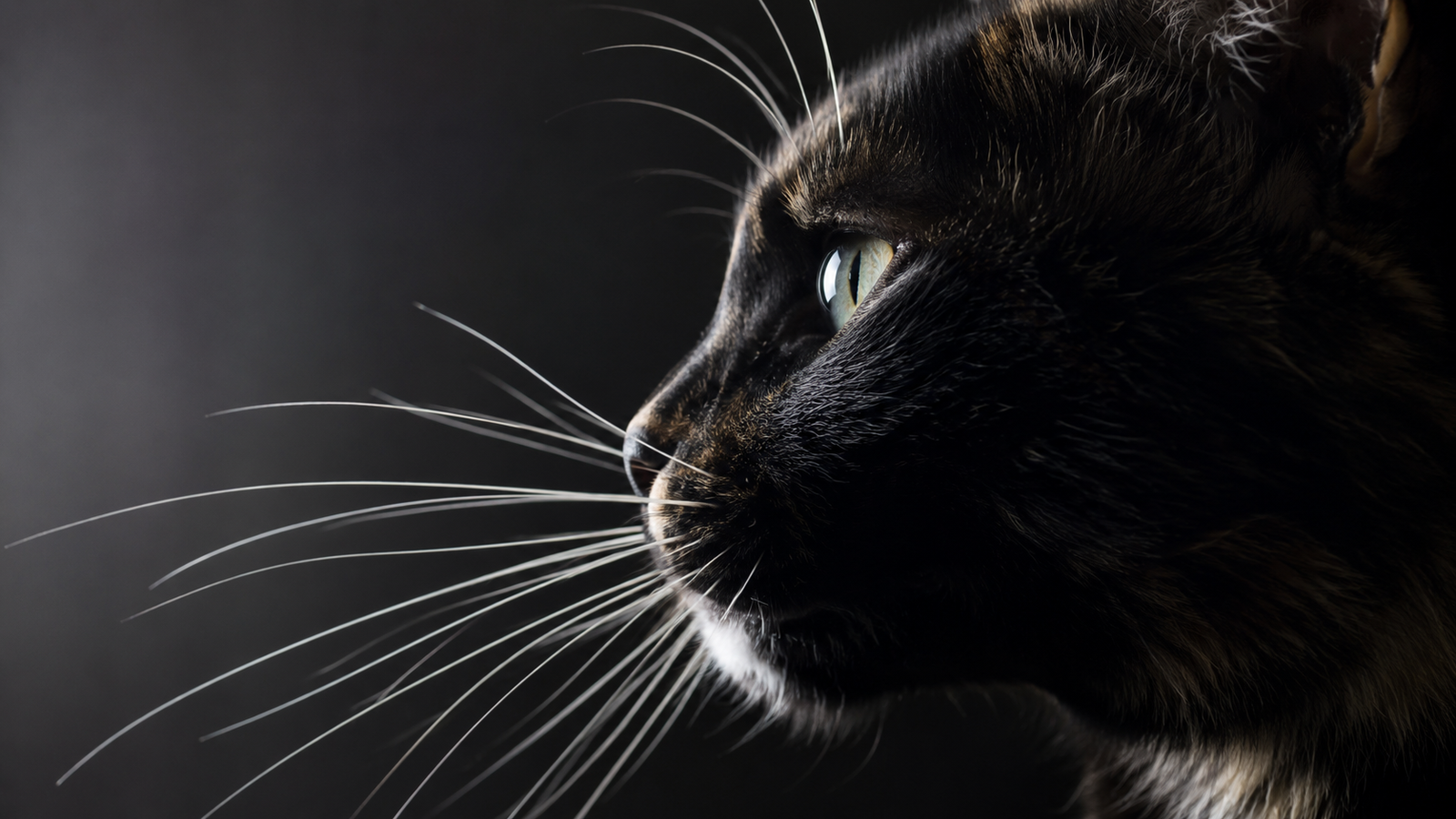
These are the main whiskers, the long, obvious ones on either side of the nose. They’re the longest and most sensitive whiskers a cat has, usually two to four inches long, and they handle most of the heavy lifting: judging gaps, navigating in the dark, and tracking prey up close. The top two rows can move independently from the bottom two, which lets a cat fan them forward when stalking prey or pull them back flat when threatened.
Eyebrow Whiskers
Above each eye sits a small cluster of two or three shorter whiskers. Their main job is protecting the eye. When something brushes them or gets too close, the cat blinks or pulls back automatically.
Chin and Cheek Whiskers
The chin and cheeks hold shorter whiskers that handle close-range sensing around the face. The chin whiskers help your cat judge how close their face is to things below them, like a food dish, the water level in a bowl, or the ground. The cheek whiskers fill in the sides, giving your cat extra coverage when their head is turned or pressed against something.
Leg Whiskers
Here’s one that surprises a lot of cat parents. On the back of each front leg, just above the paw, sits a small patch of whiskers. They point downward and backward, and they help your cat sense whatever is under their paws. When a cat has prey under their paws, the leg whiskers pick up exactly how it’s squirming, which helps the cat decide on the next move. They also help with climbing and tell the cat what’s underneath their feet on uneven surfaces.
What Do Cat Whiskers Actually Do?
Help Cats Get Around in the Dark
Cats see well in low light, but not in true blackness. When it’s truly dark, whiskers pick up tiny shifts in air bouncing off walls and furniture, which is why your cat doesn’t bump into anything at 3am.
Measure Tight Spaces
A cat’s muzzle whiskers stretch out to about the width of their body, so they work like a built-in measuring stick. Before squeezing into a tight space, your cat tests the gap with their whiskers first. If the whiskers bend back on both sides, the body probably won’t fit. Overweight cats can run into trouble here when they get wider than their whiskers.
Track Prey Up Close
Cats are actually farsighted, so anything within about a foot of their nose looks blurry. The whiskers around the nose and on the front legs sense exactly where the prey or toy is, even when the cat can’t see it clearly. That’s how a cat can deliver a precise pounce on something they’re basically too close to see.
Help With Balance
Whiskers feed information about head position and movement into the same balance system as the inner ear. It’s a small role, but it matters during precise jumps, turns, and landings.
Protect the Eyes
The eyebrow whiskers trigger a quick blink reflex when something gets too close to the eyes. That reflex helps protect your cat from twigs, furniture edges, or a swiping paw from another cat.
Show Mood
Whiskers are part of cat body language. Their position can give you a quick clue about whether your cat feels relaxed, curious, threatened, or off.
What Whisker Position Says About Your Cat’s Mood
Whisker position can give you a quick read on your cat’s mood. It works best when you look at the whole cat, including the ears, eyes, tail, and body posture. Here are the main positions to watch for.
Loose and Out to the Sides
This is the resting position. Your cat is calm and relaxed, and the loose whiskers usually pair with a chill body and sleepy eyes.
Pushed Forward, Fanning Past the Nose
Your cat is alert, curious, or in hunting mode. You’ll see this during play, when they spot something unfamiliar, or right before a pounce. Forward whiskers usually show up alongside a focused stare.
Pulled Back Tight Against the Cheeks
Your cat is scared, angry, or feeling threatened. The flat-whisker look protects the whiskers from damage if a fight breaks out, and it usually shows up alongside flattened ears, a low body, and a tucked tail.
Droopy or Slack
This one can sometimes mean your cat doesn’t feel well. On its own it’s not a red flag, but combined with hiding, low appetite, low energy, or other behavior changes, it’s a sign something may be off.
Do Different Cat Breeds Have Different Whiskers?
Most cats have standard straight whiskers, but a few breeds break the pattern.
Cornish Rex and Devon Rex cats carry a genetic mutation that affects all their hair, whiskers included. Their whiskers are often curly, crimped, or short, and some are brittle enough to break easily. The sensing still works fine; they just look a little different.
Sphynx cats, despite being mostly hairless, often still have whiskers too, though theirs may be short, sparse, or sometimes missing entirely.
On the other end of the spectrum, Maine Coons and other big breeds tend to grow proportionally longer whiskers to match their bigger bodies. A Maine Coon’s muzzle whiskers can stretch six inches or more.
Persians and other flat-faced breeds sometimes have whiskers that curl or grow at odd angles because the face shape doesn’t give the follicles room to line up normally.
Should You Ever Cut a Cat’s Whiskers?
No, never. Trimming a healthy cat’s whiskers is one of those things that seems harmless because the whisker itself doesn’t have nerves and the cut doesn’t hurt. The problem is what happens after.
A cat with trimmed whiskers loses the information they rely on to move through the world. The result is usually a confused, anxious cat that misjudges jumps, bumps into furniture, hesitates in dim light, and may even struggle with eating and drinking. It’s been compared to suddenly losing your peripheral vision: everything still looks fine, but you can’t quite trust the edges.
The only time whiskers should ever be removed is during a medical procedure, and only by a vet. Outside of that, leave them alone. The whiskers will grow back, but your cat is going to have a rough time in the meantime.
Do Cat Whiskers Fall Out and Grow Back?
Yes, whiskers shed naturally throughout a cat’s life, just like fur. Finding one or two on the floor or stuck in a couch cushion is totally normal. New ones grow in to replace them, but slower than you might expect.
A single whisker usually takes six weeks to three months to grow back to full length. Your cat might look a little uneven on one side during that time.
What’s not normal is losing a bunch of whiskers at once, or whiskers breaking off close to the skin. That can point to things like nutritional issues, hormone problems, skin infections, allergic reactions, or side effects from certain medications. If it’s happening, it’s worth a vet visit.
When to Worry About Your Cat’s Whiskers
Healthy whiskers are firm, well-anchored, and roughly even on both sides. A single shed whisker is no big deal. But some changes are worth a vet visit:
- Sudden loss of multiple whiskers, especially over a few days
- Whiskers breaking off short or becoming brittle
- Redness, swelling, scabs, or bumps around the whisker follicles
- Whiskers missing in clumps on one side of the face
- New clumsiness, hesitation in dim light, or trouble jumping
Cat Whisker FAQs
Do cats feel pain when a whisker falls out?
No. Natural shedding doesn’t hurt because the old whisker releases cleanly from the follicle. Pulling one out on purpose is a different story, and it can cause pain and bleeding.
At what age do kittens grow whiskers?
Kittens are born with whiskers already in place. They’re short and soft at birth but functional within the first few days, helping the kitten find mom and nurse before their eyes even open. By three to four months, whiskers reach close to adult length.
Can cats live without whiskers?
They can, but their quality of life takes a hit. Indoor cats in a familiar space adapt better than outdoor cats. If your cat has lost their whiskers for any reason, keep them inside and give them extra patience until they grow back.
What is whisker fatigue?
Whisker fatigue is the stress some cats may feel when their whiskers get touched too much, usually from eating or drinking out of deep, narrow bowls.
Why does my cat have a white whisker among the black ones?
Whisker color isn’t always uniform. Some cats develop white or lighter whiskers as they age, kind of like graying hair in people. It’s totally normal.
Do cats use their whiskers when they sleep?
Yep. Whiskers stay sensitive even during sleep, which is part of why cats wake up so fast at the slightest sound or air movement. Their brain doesn’t really switch the whisker input off.
Why Cat Whiskers Matter
Whiskers help cats move through everyday life with more confidence. They pick up the little details their eyes can’t always catch, especially in tight spaces, low light, or up close.
The next time you catch your cat slipping through a narrow gap or testing a shelf before jumping, pay attention. You’ll see the whiskers working.
Debbie Reid is the founder and chief editor of CatPedia.net, with over 25 years of hands-on experience in feline care, rescue, and behavior research. Inspired by her rescue cats Snickers and Bigboy, she collaborates with animal welfare resources and consults veterinary literature to turn complex feline health, nutrition, and behavior topics into clear, actionable guides.