
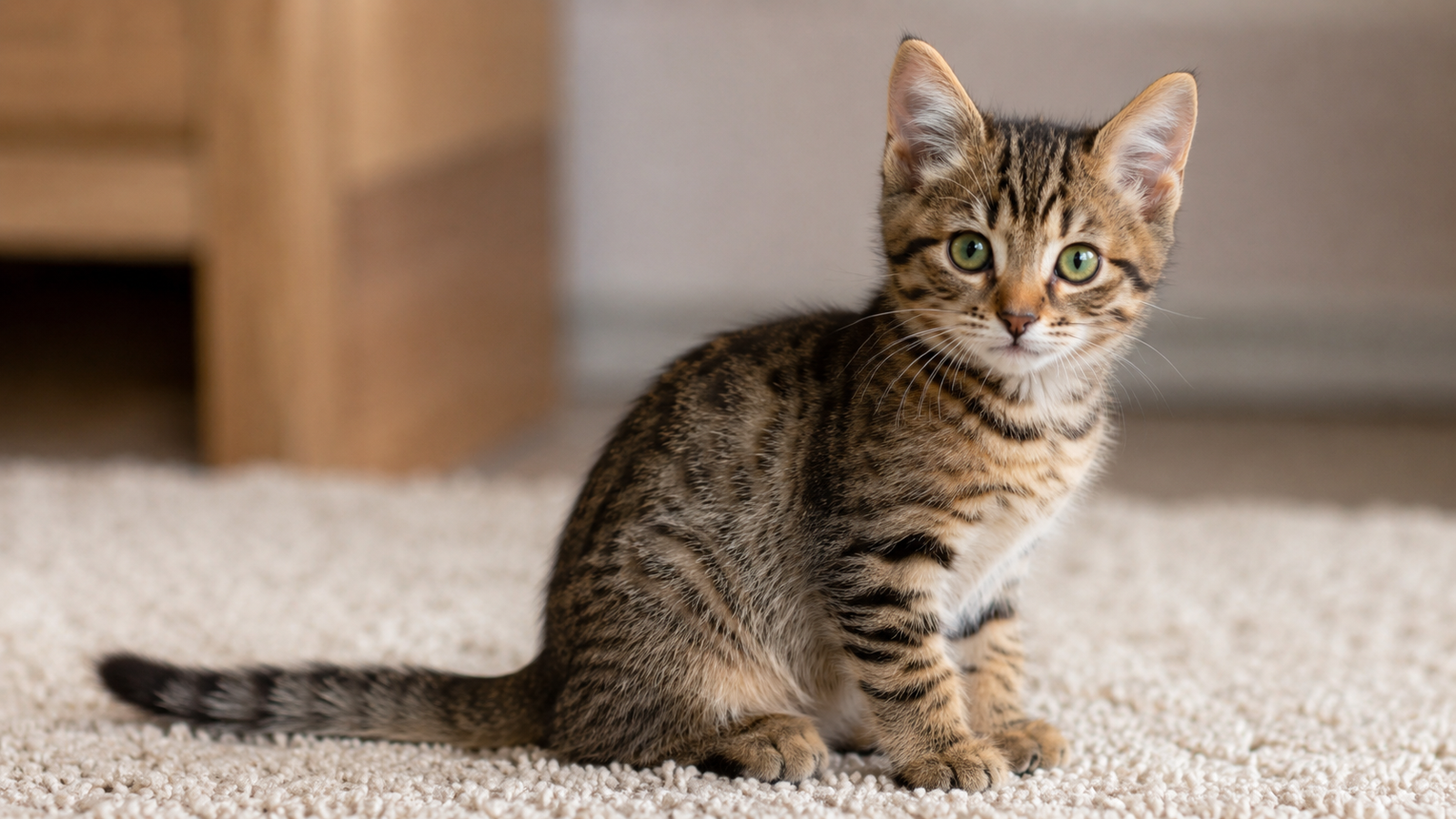
Kittens grow fast. One minute they’re tiny and wobbly, and the next they’re racing through the house with long legs, big ears, and a body that still looks a little lanky. It’s easy to wonder when they’ll stop growing, or if your cat is already adult-sized and just filling out.
Most cats stop growing between 12 and 18 months old, but that timeline can change depending on sex, breed, and early nutrition. Some kittens are nearly full-grown by their first birthday, while large breeds can keep developing for several years.
Here’s when cats stop growing, how male and female cats compare, why large breeds take longer, and how to tell whether your cat is still growing or already at their adult size.
Cat Growth Timeline by Month
Cats do most of their growing during the first year of life. The fastest growth happens in the first 6 months, then slows down as the kitten gets closer to adult size.
Here’s what you can expect at each stage of your kitten’s first two years. These are averages for healthy domestic cats, not strict rules, so try not to worry if your cat is a little ahead or behind. Breed, sex, and early nutrition can all change how quickly a kitten grows.
| Age | Expected Weight Range | Growth Stage |
|---|---|---|
| Birth | 3 to 4 oz 85 to 115 g |
Newborn kittens are tiny, blind, deaf, and fully dependent on their mother or caregiver. |
| 1 week | 5 to 8 oz 140 to 225 g |
Kittens should be gaining weight every day and spending most of their time sleeping and nursing. |
| 4 weeks | 12 to 18 oz 340 to 500 g |
Eyes are fully open, walking is improving, and kittens may start showing interest in soft food. |
| 2 months | 1.75 to 2.5 lb 800 g to 1.1 kg |
Kittens are active, playful, and usually eating solid kitten food. |
| 3 months | 2.5 to 4 lb 1.1 to 1.8 kg |
This is a fast growth period. Many kittens look leggy, curious, and slightly out of proportion. |
| 4 months | 4 to 6 lb 1.8 to 2.7 kg |
Growth is fast, and kittens often look energetic, curious, and lean. |
| 6 months | 5 to 8 lb 2.3 to 3.6 kg |
Growth is still happening, but many cats are entering the teenage stage, becoming more independent and playful. |
| 9 months | 6 to 10 lb 2.7 to 4.5 kg |
Growth begins slowing down, though many cats are not fully mature yet. |
| 12 months | 7 to 12 lb 3.2 to 5.4 kg |
Many average-sized cats are close to adult height and length by their first birthday. |
| 18 months | 8 to 12 lb 3.6 to 5.4 kg |
Most cats have reached their adult frame, though some may still fill out. |
| 24 months | 8 to 14 lb 3.6 to 6.4 kg |
Most average cats are fully grown. Large breeds may still have years of growth left. |
These numbers are only a guide. A petite adult female cat may be perfectly healthy at 7 pounds, while a large adult male may naturally weigh more. Body condition matters more than the number on the scale.
The table doesn’t fully cover slow-growing large breeds. A Maine Coon, Ragdoll, Norwegian Forest Cat, or Siberian may keep getting taller, longer, and heavier well past the first birthday.
When Do Female Cats Stop Growing?
Most female cats stop growing around 10 to 12 months old. Some keep developing until about 14 months, especially if they’re on the larger side or come from a slow-maturing breed.
Female cats usually finish growing earlier than males because their growth plates close sooner. Growth plates are the soft areas at the ends of the long bones, and once they close, the bones stop lengthening.
Spaying can shift this a little. Sex hormones help signal the growth plates to close, so females spayed before they’re fully grown may keep growing for a bit longer than they otherwise would have. This doesn’t mean your spayed cat will end up unusually large, just that her bones may take slightly longer to finish lengthening.
By the time most female cats hit their first birthday, their height and length are close to finished. After that, any changes on the scale are more likely from muscle, body condition, or a little extra weight rather than actual growing.
When Do Male Cats Stop Growing?
Most male cats stop growing between 14 and 18 months old. Many are close to their adult height and length by 12 months, but they often keep adding muscle and weight for several more months.
Male cats are usually larger than females, so their growth period can last longer. They may look lanky and a little unfinished for a while, especially during the teenage stage between 6 and 12 months.
Neutering can shift things too. Because it can delay growth plate closure, neutered males may keep growing slightly longer than they otherwise would have. The difference usually isn’t dramatic, but it can leave some neutered males looking a little taller or longer-legged than expected.
When Do Large Breeds Like Maine Coons Stop Growing?
Large breeds don’t follow the same timeline as most other cats. While many cats are close to their adult height and length by 12 to 18 months, large breeds may still be growing for years after that.
- Maine Coons: often keep growing until 3 to 5 years old.
- Ragdolls: may keep growing until around 3 to 4 years old.
- Norwegian Forest Cats: may keep growing until 3 to 4 years old.
- Siberians: can also take 3 to 4 years to reach full size.
Mixed-breed cats can inherit large-size genetics too. If your cat is a domestic shorthair or domestic longhair with a big frame, large paws, a long body, or slow steady growth past 12 months, they may just be built to mature a little later.
That’s part of why age alone doesn’t tell you when your cat will be done growing. Breed and family history matter, but many adopted cats come with no clear background. In those cases, your cat’s growth pattern, body condition, and vet checks tell you more than trying to guess their breed.
What Else Affects How Cats Grow?
Sex, breed, and spay or neuter timing all shape how fast a cat grows, and we’ve covered those above. Here are a few other things that can play a role, especially in the first few months.
- Nutrition: Kittens need enough calories, protein, and nutrients to grow well. Poor nutrition can slow growth or lead to health problems.
- Early care: Kittens from large litters or rough early environments sometimes grow more slowly, especially if they had to compete for food.
- Health conditions: Parasites, chronic illness, and rare conditions like dwarfism can slow or limit growth.
Your kitten doesn’t need to be the biggest in the litter to be healthy. Steady growth, good energy, and a healthy appetite matter more than size for their age.
How Growth Plates Work in Cats
Growth plates come up a lot in the sections above, so here’s a closer look at what they actually do. They’re small strips of cartilage near the ends of a kitten’s long bones, and they’re what allows those bones to grow longer over time.
As your cat reaches their full size, the growth plates gradually harden into solid bone. Once that happens, the bones can’t lengthen anymore. Your cat may still add muscle or a little extra weight after that, but their frame is mostly set.
If growth seems unusual or something feels off, a veterinarian can sometimes use X-rays to check the growth plates and estimate how much more growing there is left to do. It’s not something every cat needs, but it can be helpful when there’s a specific concern.
How to Tell Your Cat Has Stopped Growing
You can’t usually tell from one day to the next that your cat is done growing. It happens gradually, so the best way to spot it is by paying attention over a few months.
Your cat may be done growing if:
- Their weight stays about the same for 2 to 3 months on the same diet.
- Their body length looks about the same from month to month.
- Their body looks more balanced and less lanky than it did a few months ago.
A lot of people assume adult teeth mean a cat is done growing, but that’s not really the case. Most cats have their full set of adult teeth by around 6 months, well before many of them reach full size. Teeth can tell you they’re past early kittenhood, but the body keeps developing after that.
One trick that helps: take a photo of your cat once a month, ideally in the same spot or next to the same object. It’s easier to notice growth when you can compare photos side by side than when you’re trying to remember what your cat looked like a few weeks ago.
What to Do When Your Cat Stops Growing
Once your cat is close to their adult size, their care needs start to shift. The biggest change for most cats is what’s in the food bowl.
Kitten food is calorie-dense on purpose. Kittens need extra fuel for growing bones, muscle, and organs, so their food has more calories, protein, and fat than adult food. Once your cat stops growing, they don’t need all those extra calories anymore, and keeping them on kitten food can lead to extra weight over time.
Most cats can start switching to adult food around 12 months old. Large breeds often need to stay on kitten food longer, so it’s worth asking your vet before switching a slow-maturing breed.
When you do switch, take it slow. Mix a little adult food into the kitten food for a few days, then slowly increase the adult food while cutting back on kitten food over about a week or two. Going too fast can upset your cat’s stomach.
Portions may need to shift too. Kittens burn a lot of energy growing, playing, and getting into everything, so once they slow down, the same amount of food can start becoming too much. Measuring meals instead of leaving food out all day makes it easier to keep an eye on how much your cat is actually eating.
This is also a good time to watch for weight gain if your cat was recently spayed or neutered, since it’s common to see some extra weight settle in during the months after surgery.

When to Worry About Your Cat’s Growth
Some cats are just naturally small. A petite adult cat can be perfectly healthy at a lower weight than average, so being on the smaller side isn’t automatically a problem. What’s worth watching for is growth that stalls, drops, or falls noticeably behind.
Call your vet if your kitten:
- Stops gaining weight before 8 months old.
- Loses weight instead of gaining.
- Is much smaller than their littermates.
- Has a poor appetite or seems to struggle when eating.
- Has a swollen belly or a dull coat.
Slow growth is often tied to something treatable, like parasites, a nutrition gap, or a digestive issue. Catching it early usually means an easier fix, so a quick vet visit is worth it even if things turn out to be fine.
Is Your Cat Done Growing Yet?
Every cat follows their own timeline. Females often finish a little earlier, males may take longer, and large breeds can keep going for years. Your cat might hit their adult size right on schedule, or they might surprise you and keep filling out well past their first birthday.
What matters most is not the calendar but your cat. If they’re eating well, acting playful, and growing steadily, they’re probably right on track. If something feels off, it’s always worth checking in with your veterinarian. Either way, you’ll get to enjoy watching them grow into the cat they were meant to be.
Debbie Reid is the founder and chief editor of CatPedia.net, with over 25 years of hands-on experience in feline care, rescue, and behavior research. Inspired by her rescue cats Snickers and Bigboy, she collaborates with animal welfare resources and consults veterinary literature to turn complex feline health, nutrition, and behavior topics into clear, actionable guides.