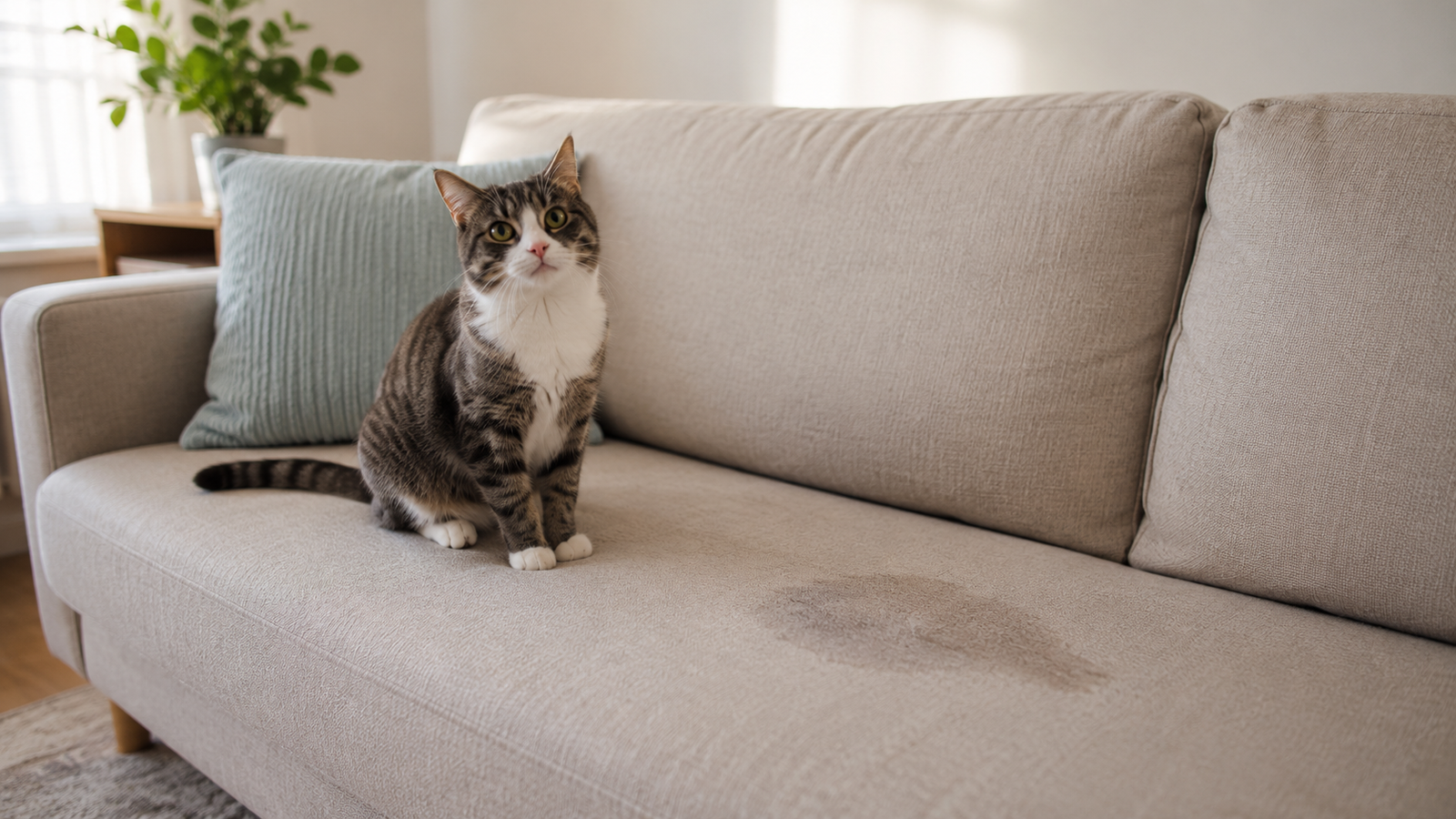
Cat urine is one of the hardest household smells to fully remove because getting rid of the stain doesn’t get rid of the smell. It soaks through carpet into the padding, seeps between floorboards, works into upholstery, and stays in clothing even after washing.
Enzyme cleaner is the only home solution that fully removes it. Below is how to use it on carpet, hardwood, tile, laminate, upholstery, mattresses, clothing, and cases where the urine has reached the subfloor.
How to Get Rid of Cat Pee Smell With Enzyme Cleaner
Enzyme cleaner breaks down the organic residue that causes the odor. Vinegar, baking soda, hydrogen peroxide, and dish soap only handle the surface smell. The residue underneath stays intact, which is why the odor can return after the area dries.
The Basic Method
- Blot the spot with clean, dry towels, pressing down hard. Don’t rub, or you’ll spread the urine and push it deeper into the fibers. Once the towels stop coming away wet, stack fresh ones over the spot and stand on them to pull moisture from deeper in the material. Repeat with fresh towels until they’re almost dry when you lift them.
- Saturate the affected area with enzyme cleaner. Use more than feels right. Urine spreads well past the visible stain and soaks deeper than the surface shows, so the cleaner has to go in heavy to reach all of it. On carpet, that means pouring rather than spraying, enough to soak into the padding underneath. On upholstery, mattresses, or fabric, keep applying until the material is fully saturated.
- Let the enzyme cleaner sit undisturbed for the full time listed on the product label.
- Once the time is up, blot up any excess cleaner and let the area air dry completely.
- If any smell remains after the area has fully dried, repeat the treatment. Older spots often take two or three passes.
Cat urine soaks below the visible surface within minutes, and the smell lives wherever the urine reached, not where the stain looks like it stopped. Undersaturating the spot is the most common reason enzyme cleaner seems to fail.
| Preview | Product | Price | |
|---|---|---|---|

|
Rocco & Roxie Extreme Enzyme Stain & Odor Eliminator Spray | Bio-enzymatic + mineral formula; Meyer... | $27.97 | View on Amazon |
Vinegar, Baking Soda, and Other Home Remedies
Vinegar
Vinegar’s acidity cuts the sharpness of urine odor on a fresh accident, but it doesn’t reach the residue that causes the deep, lingering smell. It’s a reasonable stopgap when pee just happened and enzyme cleaner isn’t in the house. Skip it on hardwood (it dulls the finish over time) and on natural-fiber carpets like wool or jute (the acid can damage the fibers).
Baking Soda
Baking soda absorbs airborne odor but doesn’t break down the compounds causing the smell. Sprinkling it on a treated spot after enzyme cleaning is fine as a finishing step. On its own, it just masks the problem. The smell comes back as soon as it’s vacuumed up.
Dish Soap
Dish soap can help clean up fresh urine on the surface, but it doesn’t remove urine that has soaked deeper into carpet, padding, upholstery, or wood. It’s fine for the initial cleanup, but lingering odor still needs enzyme cleaner.
Hydrogen Peroxide
Hydrogen peroxide lifts the yellow discoloration a urine stain leaves behind on white fabric, but it doesn’t remove odor on its own. Use it as a follow-up after enzyme treatment for visible staining on white bedding or upholstery. Skip it on colored fabric. It bleaches most dyes, and the damage isn’t visible until the fabric dries.
How to Clean Cat Pee From Different Surfaces
Carpet
Carpet is the hardest surface because urine doesn’t stay in the fibers. It soaks into the padding underneath, and sometimes into the subfloor below that. If the smell keeps returning after cleaning, urine is still trapped underneath.
Use the basic method above, but pour rather than spray so the cleaner reaches the padding. For old or set-in stains, use a UV blacklight to find the true edge of the spot. The UV blacklight section below covers the technique. Old stains often extend well past what’s visible, so saturate the entire glowing area, cover it with a damp towel to slow evaporation, and leave it several hours or overnight.
Expect to repeat the treatment two or three times for older spots, letting the area dry fully between rounds. If the smell still returns after several passes, the padding or subfloor may need to be treated directly.
Hardwood
Enzyme cleaner works on sealed hardwood floors with an intact finish. Apply it, let it sit for the full time listed on the product label, blot dry, and repeat if needed.
If the urine sat long enough to darken or warp the wood, the finish has failed and the urine has soaked into the wood itself. The affected boards need to be sanded and refinished. No cleaner will pull odor out of raw wood without physical removal of the top layer.
Tile and Grout
Sealed tile doesn’t hold odor, but the grout between tiles does. Apply enzyme cleaner across the whole area, then work it into the grout lines with an old toothbrush. Let it sit for the time listed on the label, wipe clean, and rinse with plain water. For stubborn grout, follow the enzyme step with a paste of baking soda and water, worked into the lines and left overnight.
Laminate and Vinyl Plank
The surface wipes clean easily, but the seams between planks are the problem. Urine wicks down through the seams and pools underneath. If the smell keeps returning from a laminate floor, one or more planks need to come up so the subfloor can be treated directly.
Clothes and Bedding
- Rinse the item in cold water to flush out as much urine as possible. Wring it out.
- Soak in cold water with an enzyme-based laundry detergent for at least 30 minutes, or overnight for stubborn cases.
- Wash on a cold or warm cycle with the enzyme detergent, using the amount listed on the label for a heavy load. Skip hot water. It can set any remaining odor into the fibers.
- Before drying, smell the item while it’s still wet. If any odor remains, repeat the soak and wash.
- Dryer heat can lock in any trace odor you missed, so air-dry the item instead. Outdoors in sunlight is best, since UV breaks down anything the wash left behind.
| Preview | Product | Price | |
|---|---|---|---|

|
Pet Laundry Detergent Odor Remover - ACTIVE Enzyme Based Powder Detergent for Dogs Beds, Cat Pee, HE... | $24.95 | View on Amazon |
Upholstery and Furniture
Upholstery is vertical carpet, with the same padding-underneath problem. Follow the basic method, but test enzyme cleaner on a hidden spot first. Some formulas can lift dye from older or lower-quality fabric. For cushions with removable covers, unzip and treat the inner foam and the cover separately. The foam usually holds more of the smell than the cover.
Mattresses
Mattresses are difficult to clean because you can’t wash them or fully submerge them. Urine soaks into the foam or coil layers, and if you put sheets back on before the mattress is fully dry, moisture gets trapped and the smell can come back stronger.
- Strip the bed and wash the sheets and bedding following the steps in the Clothes and Bedding section.
- Blot the mattress with dry towels, pressing down hard.
- Saturate the area with enzyme cleaner, let it sit for the full label time, then blot up as much as possible.
- Air-dry the mattress fully before putting sheets back on. This can take a full day, and a fan pointed at the spot speeds it up.
- Repeat as needed. Deep saturation often takes three or four passes.
If the smell keeps returning after treatment, the urine has soaked into foam layers that surface treatment can’t reach. The mattress may need to be replaced or professionally cleaned by a service with extraction equipment that can pull moisture from deeper layers. Once you’ve dealt with the immediate mess, put a waterproof mattress protector on the bed so the next accident doesn’t reach the mattress at all.
When the Smell Is in Your Subfloor or Walls
Cleaning the surface never fully works when the source of the smell is behind or below it. Two common scenarios: a previous owner had cats and the subfloor absorbed years of accidents, or a current cat has been going in the same spot long enough that urine has traveled through the carpet and padding into the plywood below.
Signs the problem is below the surface:
- The smell returns within days of cleaning, sometimes stronger than before
- Warm or humid weather makes it worse
- You can smell it near baseboards, floor vents, or wall outlets
- UV light shows staining beyond where the surface stain appears
For a contaminated subfloor, the flooring above it has to come up first, whether that’s carpet and padding, laminate planks, or hardwood flooring. Once the subfloor is exposed, treat it directly with enzyme cleaner, using multiple applications and letting each dry between rounds. Then seal the treated area with a stain-blocking primer like Kilz or Zinsser B-I-N before laying new flooring. The sealer traps any remaining traces so they can’t off-gas into the room.
For urine that has wicked into drywall or baseboards, the affected material needs to be cut out and replaced. No cleaner reaches deep enough into saturated drywall to remove the urine, and repainting over it only covers the problem temporarily.
When to Call in a Professional
If the urine has reached padding or subfloor you can’t easily access, or enzyme treatment hasn’t held after two or three passes, call a professional. At that point, repeating the same DIY steps is unlikely to solve the underlying problem.
Professional Carpet Cleaning
Pros can saturate the carpet deeply enough to reach the padding, then use commercial-grade extraction equipment to pull the contaminated liquid back out. That can spare you from pulling up the carpet yourself when the padding is the real source of the smell.
Ozone Treatment
Some restoration companies offer ozone treatment as a last resort for severe whole-room odors that have spread into walls, furniture, and air ducts. It isn’t a substitute for removing or treating contaminated carpet, padding, subfloor, or drywall. Ozone is a lung irritant, so the space has to be fully evacuated of people and pets during treatment and until it’s cleared for re-entry. If you’re considering it, discuss the risks and limitations with a professional restoration company rather than using a consumer ozone generator.
How to Find Hidden Cat Pee Stains With a UV Blacklight
Cat urine fluoresces under UV light, which makes a cheap blacklight the fastest way to find every spot that needs treatment. Cats often revisit a spot they can still smell even when you can’t, and old accidents extend farther than they appear on the surface.
How to use one:
- Wait until dark, then turn off all room lights. Even dim ambient light hides the fluorescence.
- Hold the blacklight 6 to 12 inches from the surface and scan slowly. Cat urine glows a pale yellow-green.
- Mark each spot with a piece of painter’s tape so you can find it again with the lights on.
- Check baseboards, the base of walls, and the sides of furniture legs. Urine spreads outward from where the cat squatted, and the edges of a stain often extend past what’s visible.
Other things fluoresce under UV too, including laundry detergent residue and some synthetic fabrics with optical brighteners. Cat urine has an irregular blotchy glow. Detergent residue usually shows as straight streaks from where it was applied, and brightened fabric glows evenly across the whole piece. If you’re unsure, verify by smell.
Never Mix Cat Urine With Bleach (Safety Warning)
As cat urine breaks down, it releases ammonia. Mixing bleach with ammonia can produce toxic chloramine gas, which causes serious respiratory damage. People have been seriously injured cleaning cat accidents with household bleach.
Never use chlorine bleach on a spot where a cat has urinated, even if you’ve already cleaned the area. Traces of ammonia can linger in the material long after visible cleanup.
Other Cleaning Product Warnings
- Don’t use ammonia-based cleaners on cat pee spots. Ammonia smells like cat urine to a cat and encourages them to return.
- Don’t mix cleaning products unless the label specifically says it’s safe.
- If you’re switching from one cleaner to another on the same spot, rinse thoroughly with plain water in between and ventilate the room.
Why Cat Pee Smells So Much Worse Than Other Animal Urine
Urine develops an ammonia smell as it breaks down. Cat urine does too, but it also contains felinine, a sulfur-containing amino acid that other mammals don’t produce. As felinine breaks down, it releases sulfur compounds that give cat urine its distinctive odor.
Many sulfur compounds have extremely low odor thresholds, which means your nose can detect them at parts-per-billion concentrations. Sulfur is behind some of the strongest smells you know: rotten eggs, skunk spray, and the odorant added to natural gas so leaks are detectable.
Intact male cats excrete roughly three times as much felinine as neutered males or intact females, and around six times as much as spayed females. Felinine production is closely linked to testosterone, which is why an unneutered male’s urine smells especially strong.
Why Is Your Cat Peeing Outside the Litter Box?
If your cat keeps peeing outside the litter box, cleaning the spot won’t solve the problem on its own. You also need to figure out why it’s happening, and the cause is usually one of four things:
- Medical. Urinary tract infections, bladder stones, kidney disease, diabetes, and arthritis can all cause a cat who’s been using the box to start going elsewhere. Rule medical causes out first with your veterinarian, especially if the behavior started suddenly.
- Litter box issues. A dirty box, the wrong litter, a box in a high-traffic spot, or not enough boxes in a multi-cat household.
- Stress or anxiety. A new pet, a new person, moving, or a change in your schedule can all trigger peeing outside the box.
- Territorial marking. More common in unneutered males but seen in fixed cats too, especially when a new animal enters the space.
For more on each of these causes and how to address them, see our guide on why cats pee outside the litter box.
How to Keep It From Happening Again
Once the spot is clean, the next step is reducing the chance your cat goes back to it. That means keeping the litter box appealing, blocking access to the old spot for a few weeks, and addressing whatever caused the accident.
- Keep the litter box clean. Scoop at least once a day, top up the litter as needed, and periodically empty and wash the box before refilling it.
- Have at least one more litter box than you have cats. Two cats means three boxes, spaced apart in different areas of the home.
- Block access to the previously soiled area for a few weeks after cleaning. Foil, plastic mats with the nubs facing up, or a physical barrier all work.
- Once the area is completely clean, change how your cat uses the spot by putting a favorite toy or scratching surface there.
| Preview | Product | Price | |
|---|---|---|---|
|
|
Rocco & Roxie Extreme Enzyme Stain & Odor Eliminator Spray | Bio-enzymatic + mineral formula; Meyer... | $27.97 | View on Amazon |
Frequently Asked Questions
What Kills Cat Pee Smell Completely?
Only enzymatic cleaner fully removes cat urine smell in a home setting. Enzymes break down the uric acid crystals and felinine byproducts that cause the odor, which no acid, base, or oxidizer can dissolve on its own. Vinegar, baking soda, and hydrogen peroxide each address one narrow piece (surface acidity, airborne odor, discoloration) and none of the three touch the underlying residue. Contamination that has reached a subfloor, wall cavity, or crawl space usually needs the affected material sealed with a stain-blocking primer or physically replaced, since enzyme cleaner can’t penetrate that deep.
Does Vinegar Actually Neutralize Cat Urine?
Partially. Vinegar can reduce the sharp odor from a fresh accident, but it doesn’t remove the urine residue that causes the smell to return later. If enzyme cleaner isn’t on hand, vinegar works as a temporary stopgap on sealed tile, laminate, or synthetic carpet, but skip it on hardwood (the acid dulls the finish) and on wool or jute (the acid damages natural fibers). Follow up with enzyme cleaner as soon as you can.
Why Does Cat Pee Smell So Much Worse Than Dog Pee?
Cats produce felinine, a sulfur-based amino acid that dogs and most other mammals don’t produce in meaningful amounts. As felinine breaks down, it releases sulfur compounds from the same chemical family as skunk spray and rotten eggs, which the human nose can detect at extremely low concentrations. Dog urine breaks down mostly into ammonia and simpler compounds that dissipate more quickly and don’t hit the same odor thresholds, which is why a small amount of cat pee smells stronger than a much larger dog accident.
How Long Does It Take to Remove Cat Pee Smell?
A fresh accident on a hard surface, treated within a few minutes, can be handled in a single cleanup. Set-in stains on carpet or upholstery often need two or three enzyme treatments spaced a day apart. Subfloor contamination or accidents from a previous owner can take weeks to fully resolve, and sometimes require sealing or replacing the affected material.
Can I Use Baking Soda Instead of Enzyme Cleaner?
No. Baking soda absorbs airborne odor but doesn’t break down the uric acid residue that causes the smell to return, so the odor comes back once the powder is vacuumed up. Combining it with vinegar (a popular home remedy) doesn’t help either. The acid and base neutralize each other on contact and leave a fizzy salt-water paste with no cleaning power against urine. Baking soda works as an optional finishing step after enzyme treatment, not as a replacement for it.
Do Ammonia-Based Cleaners Work on Cat Urine?
No. Ammonia is one of the compounds associated with urine odor, so ammonia-based cleaners can make a previously soiled spot smell familiar to your cat and encourage them to return. Check the ingredient label before using a multi-surface, glass, or floor cleaner around an accident spot, and avoid anything that contains ammonia.
Debbie Reid is the founder and chief editor of CatPedia.net, with over 25 years of hands-on experience in feline care, rescue, and behavior research. Inspired by her rescue cats Snickers and Bigboy, she collaborates with animal welfare resources and consults veterinary literature to turn complex feline health, nutrition, and behavior topics into clear, actionable guides.