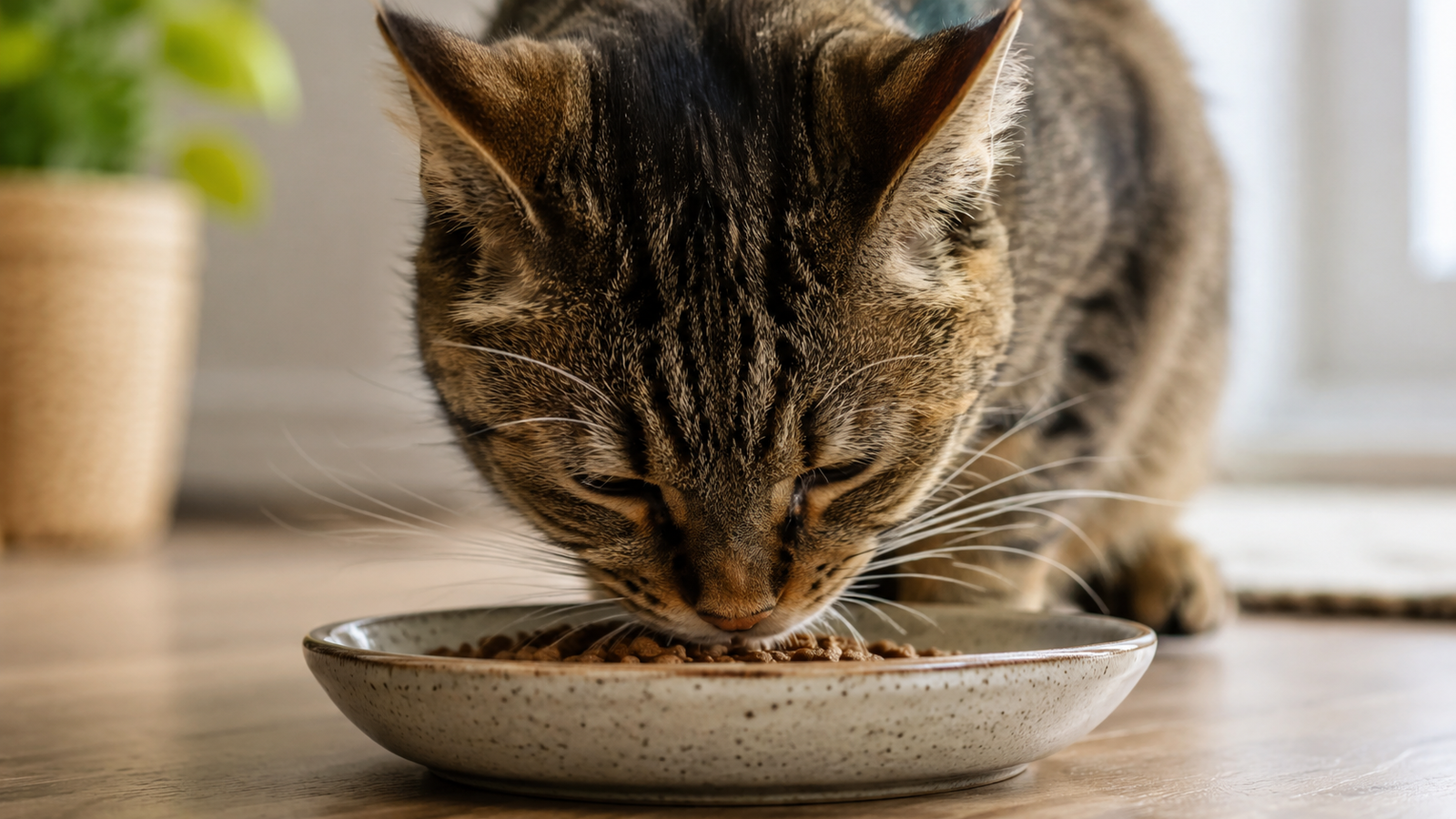
If your cat paws food out of the bowl to eat it off the floor, walks away from a full dish, or seems hesitant at mealtimes for no clear reason, you might be looking at whisker fatigue.
What Is Whisker Fatigue?
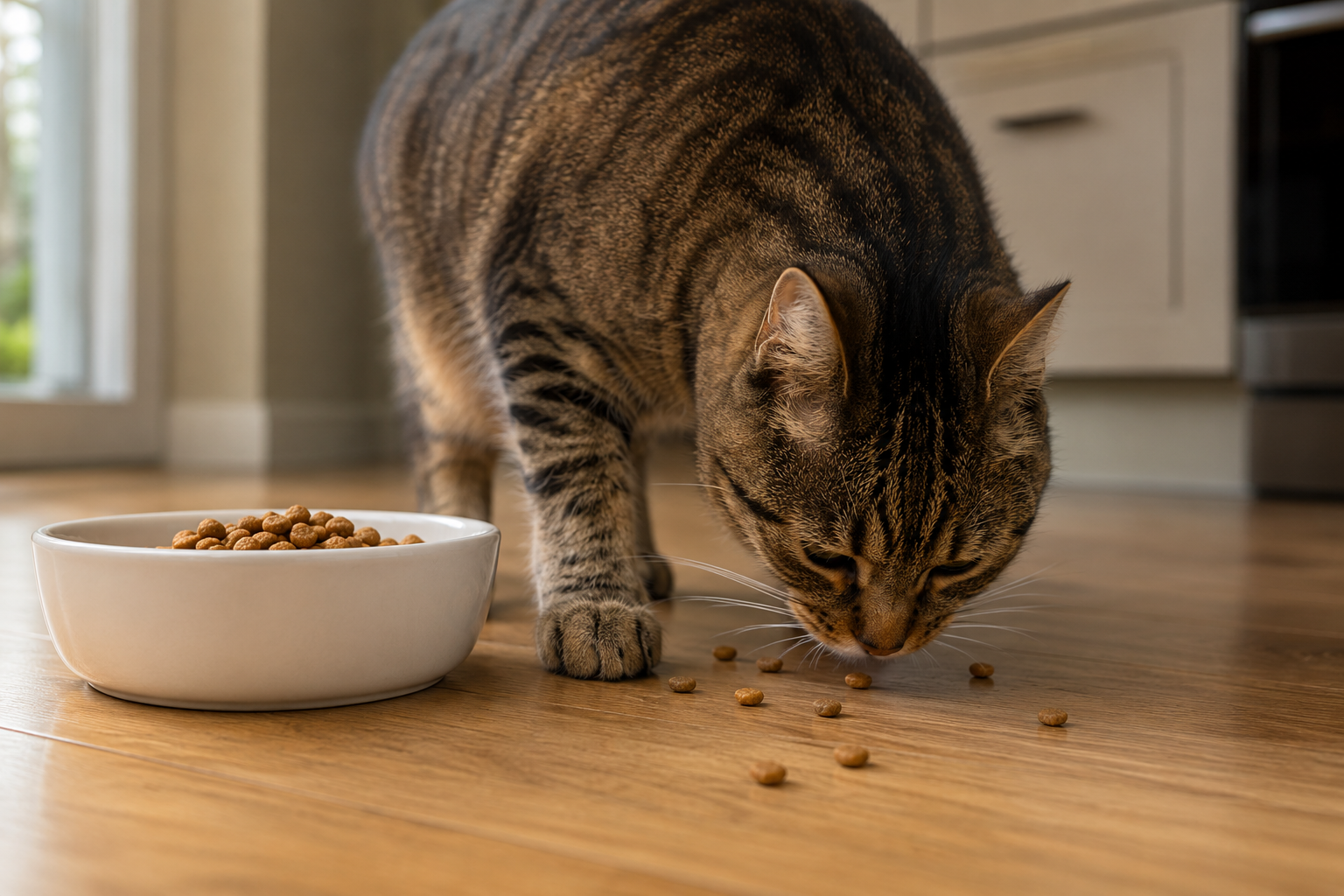
Whisker fatigue is the idea that repeated contact with the sides of a deep or narrow bowl may overstimulate a cat’s sensitive whiskers. Each time your cat lowers their head to eat or drink, the bowl may press against the whiskers. Many cats show signs of discomfort from that repeated contact and may hesitate at the bowl or find another way to reach the food.
Whiskers aren’t just longer hairs. They’re specialized sensory hairs called vibrissae, rooted more deeply than regular fur and surrounded by sensitive nerve endings. They help cats detect nearby objects, navigate in low light, and judge tight spaces. That sensitivity may also explain why some cats prefer bowls that do not touch their whiskers.
Whisker fatigue is not a firmly established medical diagnosis, and research is limited. A 2021 study found that many cats preferred a whisker-friendly dish when given a choice, although the study did not confirm that whisker contact causes pain or stress. The behavior is still worth considering because changing the bowl is simple and low-risk.
Signs of Whisker Fatigue
The signs tend to show up at mealtimes and can be easy to write off as picky eating. Watch for:
- Pawing food out of the bowl onto the floor before eating
- Walking away from a full bowl without eating
- Pacing or meowing near the food bowl without touching the food
- Tipping the bowl over to spill the food out
- Eating only from the center of the bowl and leaving the edges
- Drinking water from cups, faucets, or anywhere other than the water bowl
- Acting hungry but reluctant to actually eat
- Irritation or aggression around the food bowl
If your cat is consistently doing one or two of these, especially the pawing food onto the floor, whisker fatigue is worth considering. But if you’re also seeing weight loss, drooling, vomiting, or changes outside of mealtimes, see your vet to rule out a medical cause before assuming the bowl is the problem.
What Causes Whisker Fatigue?
The cause is almost always the bowl. Specifically, bowls that are too deep, too narrow, or shaped in a way that forces the whiskers to press against the sides every time the cat eats or drinks. Deep ceramic or stainless steel bowls with high sides are common offenders, along with narrow plastic bowls designed for water but used for food. Tapered bowls that get narrower toward the bottom are especially tough, since the whiskers get squeezed into a smaller space as the food gets eaten down.
Automatic feeders with cup-style compartments and two-in-one food and water dishes also tend to cause problems. Cats with longer or more sensitive whiskers tend to be affected more, but any cat can develop the behavior if their bowl setup is wrong for them.
How to Fix Whisker Fatigue
The fix is usually simple. Switch to a shallow, wide bowl or a flat plate that gives the whiskers room to move freely. A bowl with a wide opening and low sides lets your cat eat without their whiskers touching anything, which is all most cats need.
Look for bowls labeled as whisker-friendly, whisker-relief, or shallow-design. Avoid bowls deeper than about an inch and a half. Stainless steel and ceramic are easier to keep clean than plastic, which can also harbor bacteria that irritate the chin. Most cats start eating normally again within a day or two of the switch. If the behavior doesn’t improve after a week with a shallow bowl, it’s time to call your vet.

Whisker Fatigue and Water Bowls
The same logic applies to water. If your cat refuses to drink from their bowl but happily laps water from a cup, the sink, or a puddle outside, the bowl might be the issue. Deep water bowls are especially common offenders because owners often pick taller, narrower designs to prevent spills.
A wide, shallow water dish or a pet fountain with an open top usually solves the problem. Cats also tend to drink more from moving water, so a fountain can help with hydration in general, not just whisker comfort.
Do All Cats Get Whisker Fatigue?
No. Plenty of cats eat happily from deep bowls their entire lives without any sign of trouble. Whisker fatigue seems to affect some cats more than others, possibly due to whisker length, sensitivity, or just individual preference. Cats with naturally longer whiskers, like Maine Coons, may be more prone to it, but it can show up in any breed or mixed cat.
If your cat has been eating fine from the same bowl for years and suddenly starts showing whisker fatigue signs, the bowl probably isn’t the cause. Look for a recent change in food, household stress, or possible health issues instead.
What If It Isn’t Whisker Fatigue?
Not every food-related behavior is whisker fatigue. Pawing at food can sometimes be a leftover instinct from burying food in the wild. Walking away from a full bowl can mean the food has gone stale, the bowl is dirty, or your cat simply isn’t hungry.
The bowl’s location matters too. If it’s too close to the litter box, a noisy appliance, or a high-traffic area, your cat may avoid it for reasons that have nothing to do with whiskers. If a shallow bowl in the current spot isn’t working, try moving it to a different location.
When to See a Vet
If you’ve switched bowls, moved the location, and your cat is still acting strange at mealtimes, the issue may be medical. Common causes worth ruling out with your vet:
- Dental disease, which can make eating painful regardless of the bowl
- Kidney disease, liver disease, or inflammatory bowel disease
- Nausea from any underlying illness
- Stress from a recent move, new pet, or household change
- Bullying from another pet at the food bowl
Cats are good at hiding discomfort, so signs at the food bowl are often the first thing you’ll notice. If your cat is losing weight, drooling, vomiting, or refusing food for more than 24 hours, see your vet promptly.
For many cats showing the classic signs, though, the bowl is still the easiest place to start. It costs almost nothing, takes a day or two to test, and is sometimes all it takes to make mealtimes normal again.
Frequently Asked Questions
Is whisker fatigue real?
It’s still debated. Some veterinarians and behaviorists treat it as a real concern, while others doubt it exists. The behaviors associated with it are real and observable, and switching to a shallow bowl often resolves the issue, so it’s worth trying if your cat is showing signs.
Is whisker fatigue painful?
It’s not painful the way an injury would be. It’s more like sensory irritation, similar to how a tight collar or scratchy fabric might bother you without actually hurting. The discomfort is enough to make a cat avoid the source, but it doesn’t cause lasting harm.
Can I trim my cat’s whiskers to fix it?
Never trim a cat’s whiskers. Whiskers are sensory organs, not regular hair, and cutting them disorients your cat and removes a key tool they use to navigate the world. The whiskers will grow back, but in the meantime your cat may seem confused, bump into things, or struggle with depth perception.
How long does it take for whisker fatigue to go away?
Once you switch to a shallow bowl, most cats start eating normally within a day or two. If the behavior continues for more than a week with the new bowl, something else is likely going on.
Do kittens get whisker fatigue?
Kittens have shorter whiskers and smaller bodies, so they’re less likely to develop whisker fatigue from a standard bowl. But if you’re using a deep adult-sized bowl with a kitten, the same principles apply. A shallow dish is always a safer choice.
Debbie Reid is the founder and chief editor of CatPedia.net, with over 25 years of hands-on experience in feline care, rescue, and behavior research. Inspired by her rescue cats Snickers and Bigboy, she collaborates with animal welfare resources and consults veterinary literature to turn complex feline health, nutrition, and behavior topics into clear, actionable guides.