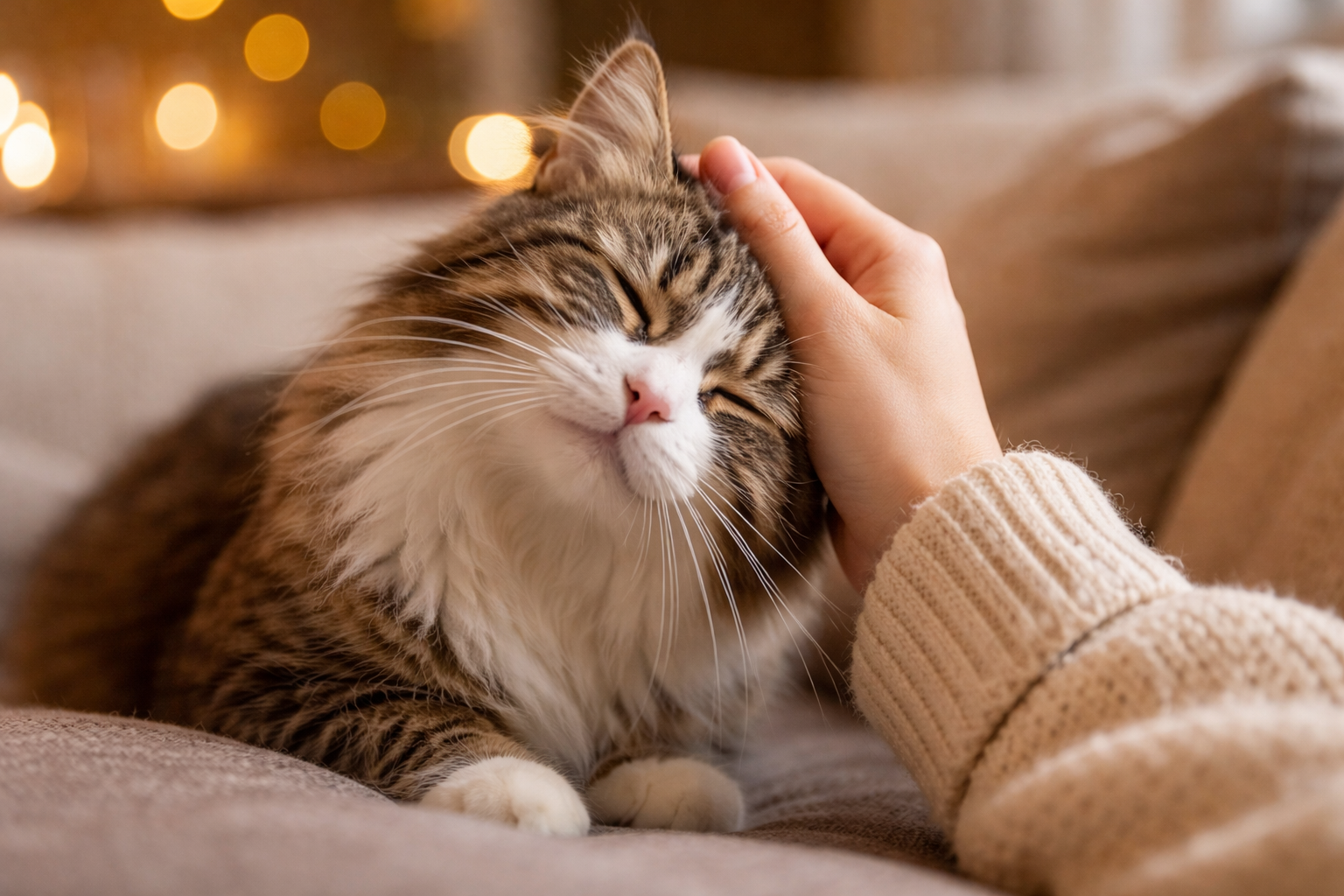
Cats don’t show love the way dogs do. There’s no tail wagging, no dramatic greeting at the door. Cat affection is quieter, more deliberate — and once you know what to look for, it becomes hard to miss.
Here’s what cat behavior research shows about how cats express love, and exactly what to watch for.
Do cats actually feel affection?
Yes. Studies on cat behavior show that cats form genuine social bonds with their owners, recognizing them as a source of safety and comfort. They’re not indifferent—they’re selective about how and when they show it.
Because cats are naturally independent, the moments they choose to seek you out, stay close, or interact with you carry real meaning. Those small behaviors are often their way of showing trust and connection.
10 ways cats show affection
1. Slow blinking
A slow blink — relaxed eyes that close softly and reopen — is one of the clearest trust signals a cat can give. It means they feel safe enough to drop their guard around you. Try slow blinking back; many cats will return it, turning it into a small back-and-forth exchange.
2. Head bunting and rubbing
When a cat presses their head against you or rubs their face along your leg, they’re depositing scent from glands around their face. This is a social bonding behavior — they’re marking you as part of their group, not just their territory.
3. Choosing to be near you
Cats don’t need to be in your lap to show affection. If your cat regularly settles in the same room — on a nearby chair, at the foot of the couch, on the floor while you work — that proximity is intentional. They’re choosing your company.
4. Following you from room to room
A cat that follows you to the kitchen or bathroom isn’t just curious. It usually means they enjoy your presence and want to stay connected throughout the day. Not every cat does this, and that’s fine — some are simply more independent.
5. Kneading
Kneading (sometimes called “making biscuits”) starts in kittenhood, when kittens knead their mother to stimulate milk. When adult cats knead your lap or a blanket near you, it’s a comfort response tied to that early security. If it’s happening while they’re near you, take it as a compliment.
6. Sleeping on or near you
Sleep is when cats are most vulnerable, so where they choose to sleep says a lot. A cat that curls up on your chest, beside your legs, or even just at the foot of the bed is showing a high level of trust. The foot of the bed still counts — they want to be in your space.
7. Grooming you
Cats groom the members of their social group — other cats, and sometimes their humans. If your cat licks your hand or hair, they’re treating you like one of their own. It’s an intimate behavior that not all cats extend to people.
8. Greeting you when you come home
A cat that meets you at the door, trots over when they hear your voice, or meows when you walk in is showing that your return matters to them. Some cats are theatrical about it; others give a quiet tail raise and a blink. Either way, they noticed you came back.
9. Showing their belly
Rolling over to expose the belly is a vulnerability display — it means your cat feels safe enough to drop their defenses around you. One important note: this isn’t always an invitation to touch. Many cats are happy to show their belly but don’t want it rubbed. Read it as a trust signal, not a petting request.
10. Vocalizing at you
Adult cats don’t meow at each other — they meow at humans. If your cat chatters at you, trills, chirps, or maintains eye contact while vocalizing, they’re communicating directly with you. Research suggests cats develop unique vocalizations for individual owners over time.
Why some cats are more affectionate than others
Personality, early socialization, and past experience all play a role. Kittens that had gentle, positive contact with people tend to become more comfortable with human interaction as adults. Cats that were under-socialized or rehomed multiple times may take longer to open up — but that doesn’t mean the capacity for affection isn’t there.
Breed has some influence too, though individual temperament matters more. The more useful frame is this: some cats show affection through physical closeness, others through proximity, others through play. Learning your specific cat’s language is more useful than expecting a standard set of behaviors.
When affection changes suddenly
A sudden shift in affectionate behavior — either much more clingy or noticeably withdrawn — is worth paying attention to. Increased neediness can signal stress, pain, or age-related anxiety. A cat pulling back may be reacting to a household change, discomfort, or illness. Cats are skilled at hiding problems, so behavioral changes are often the first visible sign that something is off. If the change is sharp or lasts more than a few days, a vet check is worth it.
Can you encourage your cat to be more affectionate?
You can’t force it, but you can make it more likely. Cats tend to open up when they feel safe, comfortable, and in control of their space. That usually means letting them come to you, keeping a steady routine, and giving them positive interactions like playtime.
It also helps to pay attention to what your cat actually enjoys. Some love curling up in your lap, while others prefer sitting nearby with just a little contact. When you respect those preferences, trust builds naturally—and that’s what leads to more affection over time.

Final thoughts
Cats do show affection. It just doesn’t always look the way people expect.
Once you start noticing the small things like slow blinks, quiet following, and the choice to stay near you, it becomes much easier to see how much trust and connection is really there.
With cats, affection is subtle, but that is part of what makes it feel genuine when it shows up.
Debbie Reid is the founder and chief editor of CatPedia.net, with over 25 years of hands-on experience in feline care, rescue, and behavior research. Inspired by her rescue cats Snickers and Bigboy, she collaborates with animal welfare resources and consults veterinary literature to turn complex feline health, nutrition, and behavior topics into clear, actionable guides.