
The Bombay cat looks like someone miniaturized a black leopard and made it want to sit in your lap. That jet-black coat, those copper eyes, and the way they carry themselves — it’s a striking combination. But the look is only part of what makes Bombay cats so appealing. They’re genuinely affectionate, easy to live with, and tend to bond closely with their people in a way that feels more loyal than aloof.
They’re also moderately demanding in the best way. Bombay cats want to be near you, involved in your routine, and acknowledged when they have something to say. They’re not high-maintenance, but they’re not hands-off either. For the right owner that balance is exactly what makes them so satisfying to live with.
Here’s what it’s actually like to live with a Bombay cat, from personality and daily habits to grooming, health, and whether they’re the right fit for your home.
Quick Breed Facts
- Origin: United States (Louisville, Kentucky)
- Breed registries: CFA, TICA
- Weight range: 6–12 lbs
- Lifespan: 12–16 years
- Coat: Short, sleek, satin-like
- Colors and patterns: Solid jet black only
- Eye color: Gold to copper
- Grooming: Low maintenance
- Activity level: Moderate
- Affection level: High
- Vocality: Low to moderate
- Good with children: Yes
- Good with other pets: Yes, with slow introductions
History & Origin of the Bombay Cat
The Bombay cat was created in the 1950s by Kentucky breeder Nikki Horner, who set out to develop a domestic cat that resembled the black leopards of India. She achieved it by crossing sable Burmese cats with black American Shorthairs, producing a cat with the sleek all-black coat and brilliant copper eyes that define the breed today. The name Bombay was chosen as a nod to India, where the black leopard is native.
The CFA officially recognized the breed in 1976. Despite their striking appearance and excellent temperament, Bombay cats remain relatively rare. Most people who have one tend to stay with the breed, which partly explains why they’re not always easy to find. There are no wild ancestors involved. The Bombay is entirely domestic, bred specifically for appearance and companionship.
Bombay Cat Personality & Temperament
The Bombay is one of the more people-oriented cat breeds you’ll find. They follow their humans from room to room, settle nearby during quiet time, and have a reliable presence that owners tend to find genuinely comforting. They’re not clingy in an anxious way. They just like being where their people are.
They’re also sociable with guests and adaptable to household changes in a way that some more sensitive breeds aren’t. Bombay cats use soft, quiet voices to communicate rather than demanding meows, which makes them easier to live with than their level of attachment might suggest. They enjoy play but aren’t hyperactive, and they’re happy to switch between an energetic game and a long nap on your lap without much transition.
Bombay Cat Appearance & Physical Traits
The Bombay has a medium-sized, muscular build that tends to feel heavier than it looks when you pick one up. Everything about their appearance is rounded: head, muzzle, ears, and eyes, which gives them a softer look than their panther-like coloring might suggest. The coat is short, tight, and has a natural satin sheen that catches light in a way that makes it look almost polished.
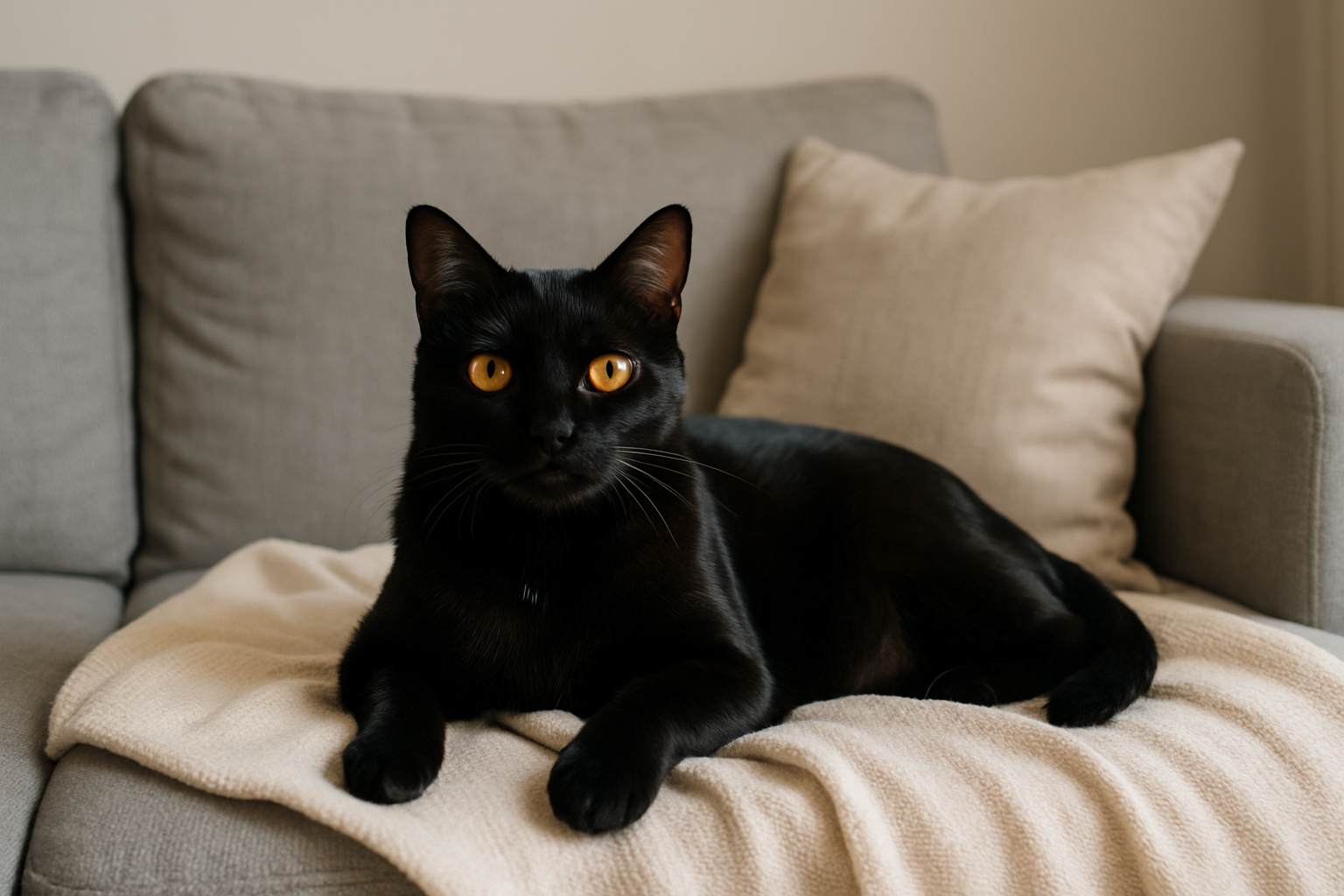
The only accepted color is solid jet black — no patterns, no variations. The gold to copper eye color provides the only contrast, and it’s a striking one. Because the coat is so dark and uniform, the quality and sheen of it matters more than with most breeds, and a well-cared-for Bombay coat is genuinely impressive to look at.
Bombay Cat Grooming & Shedding
The Bombay is one of the easier breeds to keep groomed. Their short, sleek coat sheds minimally and doesn’t mat, and a weekly brush is usually enough to remove loose hair. Many owners also run a soft cloth over the coat after brushing to enhance the natural sheen, which only takes a minute and makes a noticeable difference in how polished the coat looks.
Beyond coat care, the usual basics apply: nail trims every couple of weeks, regular ear checks, and dental care. Bombay cats tend to be cooperative about grooming when it’s introduced early, partly because they’re people-oriented enough to tolerate handling well and partly because the routine becomes another form of attention they enjoy.
Activity & Play
Bombay cats are moderately active, not as demanding as a Bengal or Abyssinian, but not content to sit still all day either. They enjoy daily play sessions and respond well to interactive toys, feather wands, and puzzle feeders. They’re curious and engaged without being relentless about it, which makes them a good fit for households that want an active companion without the intensity of a high-energy breed.
Cat trees, window perches, and access to views of the outdoors all appeal to Bombay cats. They like to climb and observe, and giving them vertical space to do that keeps them mentally stimulated between play sessions. If you’re away during the day, a puzzle feeder or rotating toy selection helps prevent boredom from setting in.

What Do Bombay Cats Eat?
Bombay cats do well on a high-protein, meat-based diet with animal protein listed as the first ingredient. One thing worth knowing about this breed is that they tend to be enthusiastic eaters and can be prone to weight gain if fed freely. Measured meals and regular mealtimes work better than free-feeding for most Bombay cats, and puzzle feeders are a good way to slow down eating while adding some mental stimulation at the same time.
A mix of wet and dry food works well for most Bombay cats. Wet food supports hydration and provides the animal protein they need, while dry food adds some dental benefit. Fresh water should always be available, and a cat water fountain encourages better hydration if your Bombay isn’t naturally drawn to a still bowl.
Bombay Cat Health & Lifespan
Bombay cats typically live 12 to 16 years with proper care. They’re generally a healthy breed, but there are a couple of conditions worth being aware of. Hypertrophic cardiomyopathy (HCM) is the most significant, a form of heart disease that can develop silently over time and is seen across many breeds. Responsible breeders screen for this, so asking about cardiac health history when choosing a kitten is worthwhile.
Weight management is the other main health consideration for this breed. Bombay cats love food and will overeat if given the opportunity, which can lead to obesity and related issues like diabetes and joint strain over time. Regular vet checkups, dental care, and consistent portion control are the practical foundations for keeping a Bombay healthy into old age.
Family Compatibility
Bombay cats are one of the more adaptable breeds when it comes to household type. They do well with families, singles, and seniors, and their steady, affectionate temperament makes them genuinely easy to integrate into most living situations. They’re patient with respectful children and tend to get along with other cats and cat-friendly dogs when introductions are handled gradually.
They do need consistent human company to stay content. Bombay cats form real attachments to their people and don’t thrive in households where they’re regularly left alone for long stretches. If you’re home often and want a cat that actively participates in daily life rather than disappearing into another room, the Bombay fits that description well.
Recommended Supplies for a Bombay Cat
Bombay cats don’t need anything elaborate, but the right setup makes a real difference in their daily comfort and enrichment. Focus on basics that support their moderate activity level and their tendency to want to be near you.
- Mid-height cat tree with stable perches for climbing and observation
- Interactive toys and puzzle feeders for mental stimulation
- Wide, shallow food and water bowls to avoid whisker fatigue
- Cat water fountain to encourage hydration
- Soft cloth or chamois for coat polishing after brushing
- Roomy, consistently clean litter box

Bombay Cat Price and Cost
From a reputable breeder, Bombay kittens typically cost between $800 and $2,000, with price varying depending on pedigree, breeder reputation, and region. Show-quality cats can cost more. Because the breed is relatively rare and breeders are fewer than with more common breeds, waitlists are common and finding a local breeder isn’t always straightforward.
Adoption is worth checking. Bombay cats and Bombay mixes occasionally appear in shelters or through breed-specific rescues, and adoption fees are significantly lower than breeder prices. If you’re open to an adult cat, it’s a genuinely good option, as adult Bombays typically have the same affectionate, people-oriented personality as younger cats.
Bombay Cat FAQs
Are Bombay cats rare?
Yes, relative to more popular breeds. Bombay cats aren’t commonly found in shelters or every cattery, and reputable breeders often have waitlists. They’re not impossible to find, but you may need to search more broadly than you would for a more common breed.
Are Bombay cats hypoallergenic?
No, Bombay cats are not hypoallergenic. All cats produce the Fel d 1 protein that triggers allergies. Their short, low-shedding coat may make them slightly more manageable for some allergy sufferers, but there are no guarantees.
How long do Bombay cats live?
Most Bombay cats live 12 to 16 years with proper care. Regular vet checkups, weight management, and dental hygiene all contribute to a longer, healthier life.
What do Bombay cats eat?
Bombay cats do best on a high-protein, meat-based diet. Because they tend to overeat, measured meals work better than free-feeding. A mix of wet and dry food is a good approach for most cats of this breed.
Do Bombay cats get along with dogs?
Usually yes, with gradual introductions. Bombay cats are confident and adaptable, which makes them more tolerant of dogs than more timid breeds. Supervised early meetings and giving each animal their own space helps the transition go smoothly.
How much does a Bombay cat cost?
Pet-quality Bombay kittens from a reputable breeder typically cost between $800 and $2,000. Show-quality cats can cost more. Adoption through a rescue is a more affordable option if you’re open to an adult cat.
Is the Bombay Cat Right for You?
If you want a strikingly beautiful, affectionate, and easy-to-live-with cat that genuinely enjoys your company, the Bombay is hard to beat. They suit a wide range of households, don’t demand constant entertainment, and bring a calm, loyal presence to daily life that most owners find they quickly can’t imagine being without.
The main thing to think through honestly is their need for company. Bombay cats do best when someone is home regularly and can give them the attention they thrive on. Get that right and the Bombay will be one of the most rewarding cats you’ve ever lived with.
Debbie Reid is the founder and chief editor of CatPedia.net, with over 25 years of hands-on experience in feline care, rescue, and behavior research. Inspired by her rescue cats Snickers and Bigboy, she collaborates with animal welfare resources and consults veterinary literature to turn complex feline health, nutrition, and behavior topics into clear, actionable guides.