
Research has confirmed that cats can distinguish their name from similar-sounding words. But how often do you actually call your cat by their name? Most of the time, it’s one of the dozen nicknames you’ve come up with, yet they still seem to know you’re talking to them.
Do Cats Know Their Names?
A 2019 study published in Scientific Reports tested 78 cats in a series of four experiments. Researchers played recordings of four everyday nouns matched to each cat’s name for length and rhythm, followed by the cat’s actual name. At first, the cats reacted to the recordings with small movements like a head turn or a twitch of an ear. Many gradually tuned the words out, but reacted again when their own name was played. They could pick it out even when the recording was made by someone they didn’t know.
This shows that cats can distinguish their name from other words. What the study doesn’t prove is that they understand it as a label for themselves. The researchers suggested that cats learn through association. They hear their name before receiving food, attention, or play, and eventually learn that the sound means something relevant may be about to happen.
The same kind of learning could explain why cats respond to nicknames.
Do Cats Recognize Nicknames Too?
No study has tested nickname recognition directly, so we can’t say for certain. But if a cat learns their name through repeated use and what usually follows it, a nickname used the same way can build the same kind of association.
“Munchkin” and “sweetie” sound nothing like the name on the vet records, but that doesn’t matter much. Each becomes a familiar sound linked to your voice, your tone, and what usually happens when you say it.
Do Cats Recognize Your Voice or Just Their Name?
The answer is both. Cats can recognize the sound of their name, but they also know who is saying it. A 2013 study found that cats could distinguish their owner’s voice from a stranger’s. Their reactions were often subtle. An ear moved or their head turned, but they didn’t necessarily get up or approach the sound. They recognized the voice; they just didn’t rush over to prove it.
Cats also notice how their owners speak to them. In a 2022 study from Université Paris Nanterre, cats responded differently when their owner used the higher-pitched, affectionate voice reserved for them than when the same person spoke normally to another adult. When a stranger used those same two speaking styles, the cats didn’t show the same distinction.
So when your cat looks up after hearing a nickname that sounds nothing like their real name, the nickname may be only part of what they recognize. Your familiar voice and the way you speak to them may be helping too.
Can Cats Tell Their Name Apart From Other Cats’ Names?
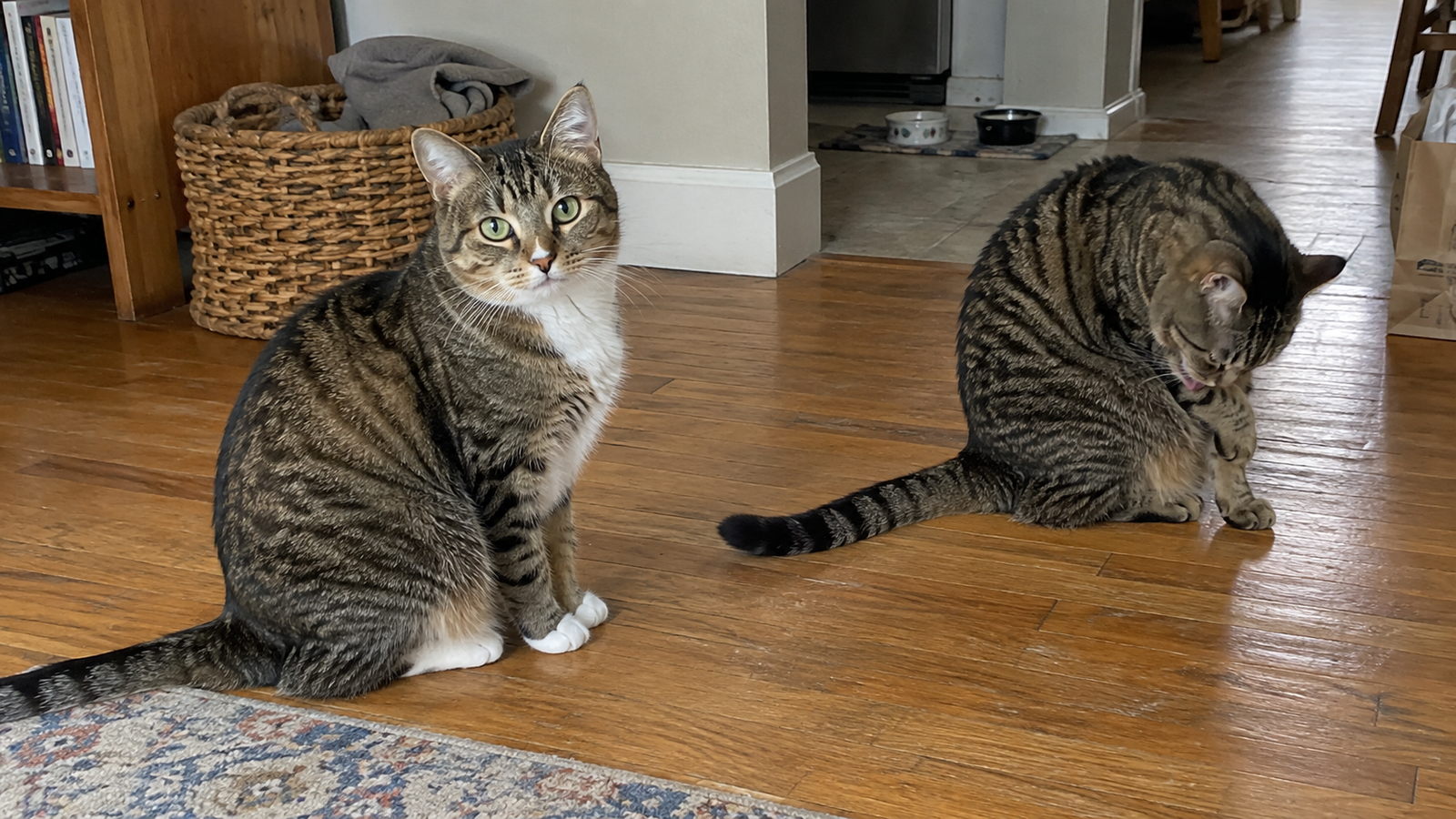
The 2019 study tested this too. Cats living in multi-cat households heard the names of their housemates before hearing their own. Those that gradually tuned out the other names reacted again when their own was played. This suggests that cats can distinguish their name even from other names they hear regularly in the same home.
Cats living in a cat café showed a different pattern. They could distinguish their name from ordinary words, but not from the names of the other cats around them. The researchers suggested this may be because café cats hear many names used by many different visitors, often around the same interactions. That can make it harder for each name to become strongly associated with one particular cat.
A nickname can work as an individual signal if it’s used for one cat. But if you call every cat “sweetie,” it becomes a shared signal rather than a clue about which cat you mean. Your cats may still figure it out from your voice, eye contact, or where you’re looking, but the nickname alone doesn’t distinguish one cat from another.
Why Does My Cat Ignore Their Name?
Recognition and response aren’t the same thing. A cat may hear their name and recognize your voice without having any particular reason to come over.
The response may also be smaller than you expect. An ear turning in your direction, a tail flick, or a slight shift in posture can show that your cat heard you. These signs are easy to miss if you’re waiting for them to get up and come running.
Sometimes your cat is simply focused on something else. A bug on the wall, birds outside the window, or a particularly good nap may be more interesting than whatever you’re offering at that moment.
How Do Cats Learn Their Names?
A name works through association, so teaching one is less about repetition on its own and more about what follows the sound. The more often your cat’s name is paired with something they want, the more reason they have to pay attention when they hear it.
The basic method is straightforward:
- Say your cat’s name once, in a normal, upbeat tone.
- The moment they look at you, give a small treat, praise, or a few seconds of petting, whatever your cat actually values.
- Keep sessions short. A minute or two, a few times a day.
- Once they respond reliably nearby, practice from across the room, then from another room.
- Gradually add mild distractions so they’ll still respond when something else is going on.
Cats can learn a name at any age, including adult cats adopted from a shelter. In a multi-cat home, work with one cat at a time so the reward is clearly connected to the name you just said.
Avoid using the name to scold, and try not to say it right before a bath, a nail trim, or the carrier. Most uses of the name should lead to something neutral or good.
Stick with their real name during training. Nicknames can come in later, and each will build its own association through repeated use.
Can You Rename a Cat?
Yes. Cats can learn a new name at any age by hearing it repeatedly and connecting it with attention, food, play, or other things they value.
If your cat already responds to their old name, say the two together for a while (“Bella-Luna, dinner”) and reward them for looking up. As the new name starts getting a response on its own, use it more often and drop the old one when you’re ready.
If your cat rarely responded to the old name (common with shelter cats who only had it briefly, or cats mostly called by generic terms), you can skip the overlap and start fresh. Say the new name once, reward any glance in your direction, and practice in short sessions.
Occasionally using the old name won’t undo your progress. But the more consistently you use the new one during training, the faster it becomes the sound your cat learns to respond to.
Debbie Reid is the founder and chief editor of CatPedia.net, with over 25 years of hands-on experience in feline care, rescue, and behavior research. Inspired by her rescue cats Snickers and Bigboy, she collaborates with animal welfare resources and consults veterinary literature to turn complex feline health, nutrition, and behavior topics into clear, actionable guides.