
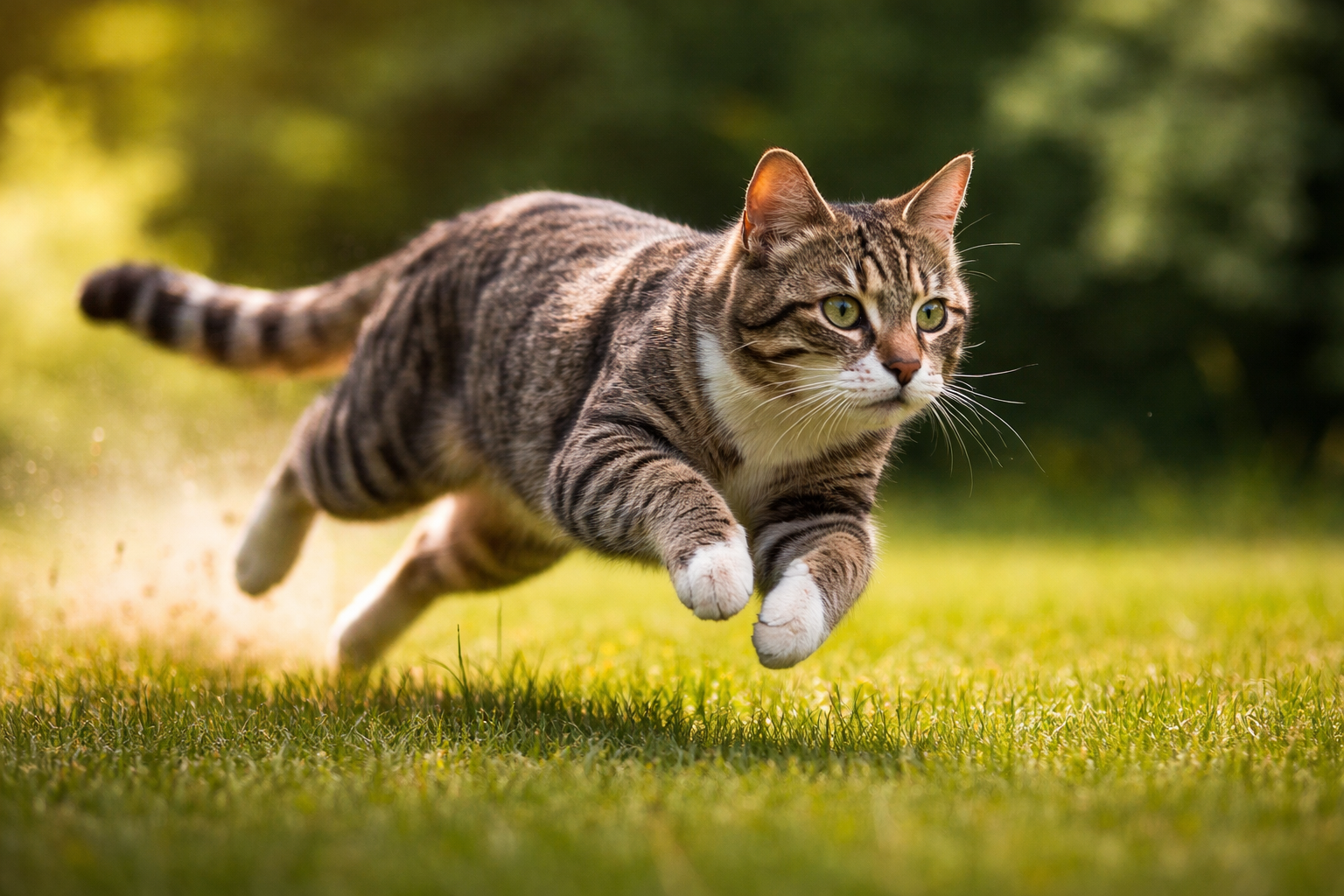
Have you ever watched your cat suddenly tear through the house at full speed? One second they’re lounging on the couch, and the next they’re a blur racing down the hallway.
Cats are fast — a lot faster than most people realize.
How Fast Can a Cat Run?
Most domestic cats can reach speeds of up to 30 miles per hour in short bursts. That might not sound extreme at first, but it’s incredibly fast for an animal that weighs around 10 pounds.
For comparison, the fastest human ever recorded—Usain Bolt—reached about 27 miles per hour at his peak. The average person doesn’t come close to that.
Cats can’t keep that speed for long, though. They’re built for quick, explosive sprints rather than long-distance running.
Why Cats Are So Fast
A lot of it comes down to how their bodies are built.
Their back legs are packed with muscle, which lets them push off the ground with a lot of force. At the same time, a cat’s flexible spine acts like a spring, stretching and snapping back with each step to help them cover more ground.
They also walk on their toes instead of flat feet, which keeps them light and quick.
It all works together to help them go from completely still to full sprint in seconds.
What Affects a Cat’s Running Speed?
Not every cat is going to reach that 30 mph top speed. Just like people, there’s a wide range when it comes to athletic ability.
Breed plays a role. Some cats are naturally more athletic and closely resemble their wild ancestors. Others are built more for comfort than speed.
Age matters too. Younger adult cats tend to be the fastest, while kittens and senior cats are usually slower.
Weight and overall health can make a big difference. Cats that are overweight or less active won’t move as quickly as those in good physical condition.
Lifestyle also comes into play. Indoor cats don’t always get as many chances to run at full speed, while outdoor cats tend to stay more conditioned.
Fastest Cat Breeds
Some breeds are built more for speed than others. The Egyptian Mau is often considered the fastest domestic cat, known for reaching speeds even higher than average. Other fast breeds include the Bengal, Abyssinian, and the Savannah cat — all lean, muscular, and naturally high energy.
Can a Cat Run Faster Than a Dog?
It depends on the dog. Most domestic cats top out around 30 mph, while the average dog runs somewhere between 15 and 25 mph — so in a short sprint, your cat would likely win.
That said, some dogs aren’t even close to average. Greyhounds can hit over 40 mph, which no domestic cat can touch. But those are the exception, not the rule.
How Fast Is That in Real Life?
Thirty miles per hour is much faster than it sounds — especially in a small space. When your cat runs from one end of the room to the other in a split second, that’s their speed at work. A full-speed dash across a hallway can happen so quickly it’s over before you even react.
Those sudden bursts — often called zoomies — are your cat tapping into that natural sprinting ability, even inside your home.
Final Thoughts
Next time your cat tears through the house out of nowhere, just know — that’s thousands of years of evolution at work. They were built for speed.
Debbie Reid is the founder and chief editor of CatPedia.net, with over 25 years of hands-on experience in feline care, rescue, and behavior research. Inspired by her rescue cats Snickers and Bigboy, she collaborates with animal welfare resources and consults veterinary literature to turn complex feline health, nutrition, and behavior topics into clear, actionable guides.