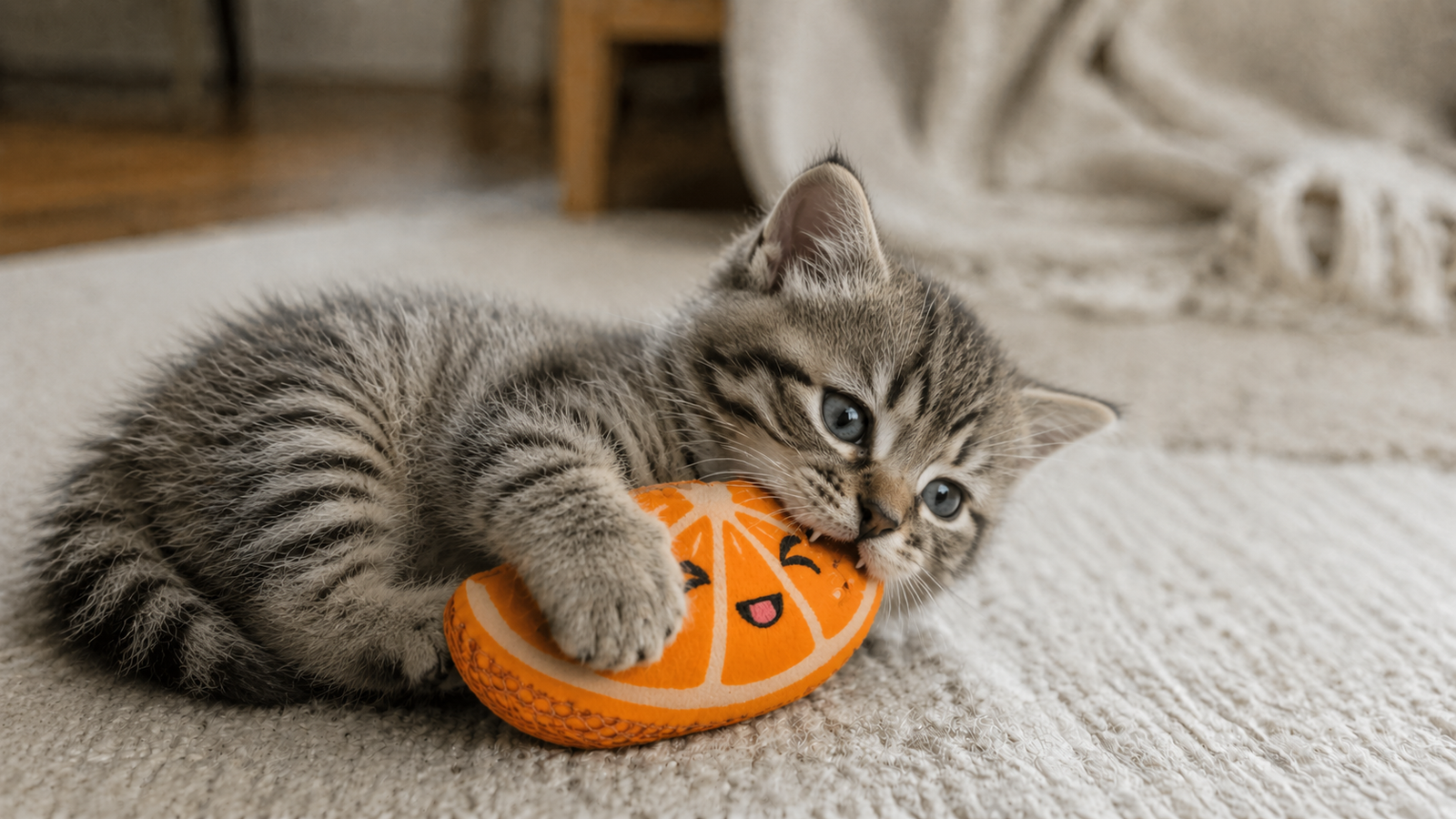
If your kitten has started gnawing on charger cables, chair legs, or the corner of your favorite blanket, they are almost certainly teething. Their gums hurt, their mouth feels strange, and chewing helps relieve the discomfort.
Scolding them or spraying them with water won’t stop the urge. Give them a better target instead—something soft enough for baby teeth but firm enough to satisfy them.
Most kittens do best with two or three teething toys in rotation: soft mesh for tender gums, rubber for firmer resistance, and silvervine for the strongest chewers.
What Makes a Kitten Teething Toy Safe and Effective?
A good teething toy needs some give when bitten, but it also has to withstand daily chewing without breaking into pieces a kitten can swallow.
What to look for:
- Soft but firm. Rubber, mesh-covered plush, and natural silvervine give your kitten something to press their gums against without being as rigid as hard plastic or nylon. For rubber and fabric toys, look for material that bends slightly or dents when pressed with a fingernail.
- No small breakaway parts. Plastic eyes, feathers, and thin ribbons can be chewed off and swallowed. If a toy has any of these, either trim them before the first play session or skip the toy. Check favorite toys weekly for damage.
- Sized for a small mouth. Your kitten’s jaw has to fit around the toy. Adult cat chew toys are often too bulky and end up ignored.
- Non-toxic. Anything your kitten will regularly put in their mouth should be made from pet-safe materials.
Catnip and silvervine are bonuses, not requirements. For a teething toy specifically, the texture and chew resistance matter more than what’s inside.
Don’t Let Your Kitten Chew on Your Hands
It’s tempting to wiggle your fingers for a kitten to gnaw on, especially while the bites are still soft. Skip it. A kitten who learns that hands are fair game may carry that habit into adulthood, when the teeth and jaws are considerably bigger.
If your kitten grabs a finger, hold still instead of pulling away and turning it into prey. Once they let go, redirect them to a toy they are allowed to bite.
Mesh and Fabric Chew Toys
Mesh is the default recommendation for kittens. The woven texture gives sore gums something to press against, grips against baby teeth as they chew, and stays soft enough that a two-month-old kitten can chew it without damage.
Catstages Dental Fruit Wedges (4-Pack)
| Preview | Product | Price | |
|---|---|---|---|

|
Catstages Dental Fruit Wedges Chew Cat Toys with Catnip, 5.3", 4-Pack | Textured Dental Mesh, Helps... | $3.97 | View on Amazon |
These four small plush wedges (lime, grapefruit, orange, and lemon) are sized for a young kitten to pick up and carry. The mesh covering gives sore gums something textured to press against, and having four helps when one inevitably disappears under the couch.
They’re made for gentle chewing, not shredding. Check the seams and mesh regularly and toss any wedge that starts fraying.
Catstages Dental Banana Cat Toy
| Preview | Product | Price | |
|---|---|---|---|

|
Catstages Dental Banana Cat Toy with Catnip, Dental Mesh & Crinkle Sound, Interactive Kicker for... | $4.24 | View on Amazon |
The banana is a longer, thinner mesh toy at just over five inches, which lets kittens grab it and bunny-kick it. The whole yellow body is dental mesh, and the pale stem end is soft plush.
It has a crinkle layer inside, plus catnip for once your kitten’s old enough to respond to it.
Toss it once the mesh starts fraying or the plush stem tears open.
Natural Silvervine Chews
Silvervine is a woody vine from East Asia. As a teething chew, it sits between soft mesh and hard plastic: firm enough to push back against sore gums, soft enough not to crack baby teeth. Kittens may not react to the scent itself until they’re a few months older.
Both toys below use silvervine wood in different formats. Tiny slivers coming off as your kitten chews are normal and generally pass through their system without issue. Toss the toy if it splinters, breaks into larger pieces, or develops a sharp edge.
Potaroma Silvervine Sticks (3-Pack)
| Preview | Product | Price | |
|---|---|---|---|

|
Potaroma 3 Pack Natural Silvervine Sticks Cat Toys, Catmint Silvervine Blend Sticks, Catnip Kittens... | $6.98 | View on Amazon |
Each stick is a silvervine branch wrapped in sisal rope, with raffia and silvervine gall fruit tied at the ends. Kittens hold them between their front paws and gnaw on the ends. Replace once the sisal or raffia starts unraveling.
Potaroma Silvervine Cage Balls
| Preview | Product | Price | |
|---|---|---|---|

|
Potaroma Catnip Toys, 3Pcs Cat Toys Natural Silvervine Stick Cage Balls & Bell Ball for Indoor Cats... | $9.98 | View on Amazon |
The outer cage is handwoven from thin silvervine sticks, with catnip, silvervine gall fruit, and a small bell inside. Kittens chase the ball, pin it down, and chew on the woven sticks once they’ve caught it. It’s a better fit than a straight stick for kittens who’d rather chase and pounce than sit and gnaw.
The woven cage can loosen under repeated chewing. Supervise play and toss the ball if the sticks splinter, the cage starts coming apart, or the bell becomes exposed.
Rubber Chew Toy
Rubber gives kittens something firmer to bite into than mesh or plush, without the sharp edges of hard plastic. The bumpy surface of a good rubber chew presses back against sore gums.
Catstages OrkaKat Wiggle Worm
| Preview | Product | Price | |
|---|---|---|---|

|
Catstages OrkaKat Wiggle Worm Dental Cat Chew Toy with Catnip, 3.8" | Supports Clean Teeth... | $3.99 | View on Amazon |
The Wiggle Worm is a firmer option for kittens that make quick work of soft mesh toys. It’s a 3.8-inch piece of food-safe rubber shaped like a fat caterpillar, with rows of raised bumps that press against the gums as they bite.
Check the rubber regularly and toss it if it tears or your kitten bites off a piece.
How Do I Help a Teething Kitten at Home?
A couple of things beyond toys can help.
Freeze a wet washcloth. Soak a clean washcloth, wring it out, fold it, and put it in the freezer. Once frozen, let your kitten chew on the corners. Cold numbs sore gums fast. Wash and refreeze between uses, and toss the washcloth once it starts fraying.
Kitten-proof your cables. A kitten who bites through a live cable can suffer a severe electrical shock or burns inside the mouth. Cover exposed cables with split-loom tubing (a few dollars at any hardware store), or apply a pet-safe bitter deterrent like Grannick’s Bitter Apple.
What Should You Avoid Giving Your Kitten to Chew On?
Some common household items can seriously injure a kitten if chewed or swallowed.
- Hard dog chew toys. Built for adult dog jaws, they can crack a kitten’s baby teeth.
- Cooked bones. They splinter and can puncture the throat or gut.
- String, yarn, ribbon, and hair ties. Once a kitten starts swallowing string, the tiny backward-facing hooks on their tongue (papillae) make it difficult to spit back out. It can get caught in the intestines and require surgery to remove.
- Rubber bands and elastics. Same swallowing risk, plus they can wrap around the tongue and cut off circulation.
- Anything with small removable parts. Googly eyes, buttons, plastic decorations. If a kitten can pull it off, they’ll try to swallow it.
If you catch your kitten chewing on something from this list, don’t chase them. Chasing turns it into a game and they may swallow it faster. Offer a real toy in trade or distract with a treat, then pick it up once they’ve dropped it.
Frequently Asked Questions
At What Age Do Kittens Need Teething Toys?
Most kittens come home at eight to twelve weeks with their baby teeth already in, and the second round of teething starts around three to four months as their adult teeth begin coming in. That’s when chewing usually gets worse and teething toys earn their keep. If you’re raising a very young kitten from two to four weeks old, the tiny baby teeth are pushing through then too — but at that age they’re chewing on littermates and mom, not toys.
How Long Does the Teething Stage Last?
Teething starts when your kitten’s baby teeth begin coming in at two to four weeks old and ends when all 30 adult teeth are in, usually by six or seven months. See what a kitten’s teeth look like at each age.
Silvervine vs Catnip: What’s the Difference?
Catnip is a mint-family herb. Silvervine is a woody vine from East Asia. Both can trigger the rolling, rubbing, and playful reaction cats are known for, but silvervine works on more cats: roughly 80% respond, compared with 68% for catnip.
When Should I Call the Vet About Teething?
Some drooling and mild gum tenderness are normal during teething. Call your vet if your kitten stops eating, seems to be in real pain, has severely swollen gums, is bleeding heavily from the mouth, or has a foul smell or discharge around a tooth.
Debbie Reid is the founder and chief editor of CatPedia.net, with over 25 years of hands-on experience in feline care, rescue, and behavior research. Inspired by her rescue cats Snickers and Bigboy, she collaborates with animal welfare resources and consults veterinary literature to turn complex feline health, nutrition, and behavior topics into clear, actionable guides.